

Post Introduction
I live in a late 1940’s neighborhood just on the outside edge of Salt Lake City proper. Downtown city dwellers might call it suburban, and true suburbanites would call it urban. The point is that wild land nature does not physically encroach on my 0.14 acre/0.06 hectare yard. Therefore, I have to proactively work to connect with nature. I do so by observing the daytime and nighttime skies, by observing the mountain peaks and flanks which are single digit miles/double digit kilometers from the vantage point of my yard, and by observing resident and migratory birds of many types who nest near by or fly over my house. I also connect with nature by carefully cultivating 2500 square feet/ 232 square meters of Kentucky blue grass, 18 rose bushes, a dozen heirloom Moscow tomato plants, and a dozen pumpkin plants of various sorts. My spouse also tends to many different annual and perennial flowering plants. The reality is that I am 30 minutes away from alpine mountains, the Great Basin Desert, and the sixth largest lake in the USA, the Great Salt Lake.
Beginning in the dead of winter in early 2016, the idea of photographing the first sun rays of summer just as they hit the peaks of the central Wasatch Mountains occurred to me. I searched out a vacant lot about 0.6 mile/one kilometer from my house in order to get a relatively unobstructed view of the mountains. With the sun rising in the northwest, the sun rays would be traveling southwest from behind the Wasatch Mountains to arrive on the backs and side of the peaks, a light path seen only a few months of the year and at its most extreme on the summer solstice. In other words, because the Wasatch Mountains run north and south, the sun’s rays would be oblique to the peaks and their granite bases as the photons came from behind. Sunrise was 5:56 (all times MDT) but that was at the horizon which was not visible from my location due to the Wasatch Range. These photos were taken from 5:55 to 6:27. The sun did not pop up over the mountain ridge and illuminate the valley floor at my vantage point until about 6:45. Thus in all these photos, the sun’s direct rays were at work from behind the mountains, and the ball of the sun was not yet visible in the sky. Note that, although all six photos represent the summer solstice, all have water ice in them.

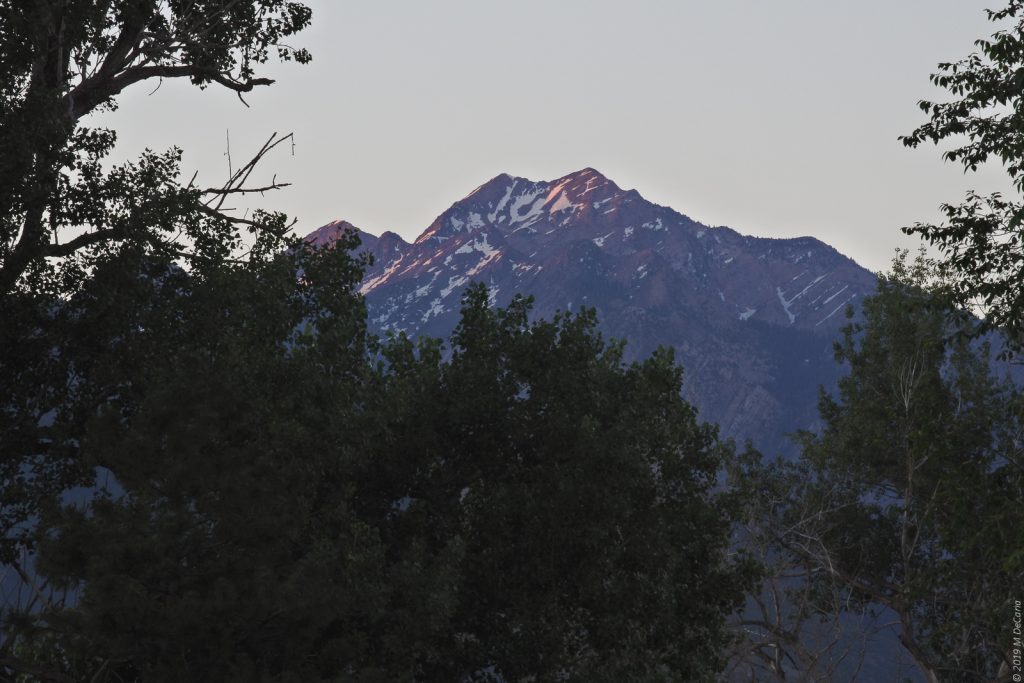
Twin Peaks-First Light of Summer
5:55 AM MDT. As suggested in the blog introduction, the sun’s rays are traveling from the northeast (the left) down Big Cottonwood Canyon. Broad Fork’s Twin Peaks are the southern sentinels of the canyon. Although the mountain range is oriented north and south, the peaks are oriented west and east with the eastern one (on the left) just two feet/61 cm taller than its twin. The eastern summit is 11,330 feet/3453 meters. To the left of the twins is the aptly named Sunrise Peak at 11,275 feet/3437 meters. Topographic maps label Sunrise as O’Sullivan’s Peak.
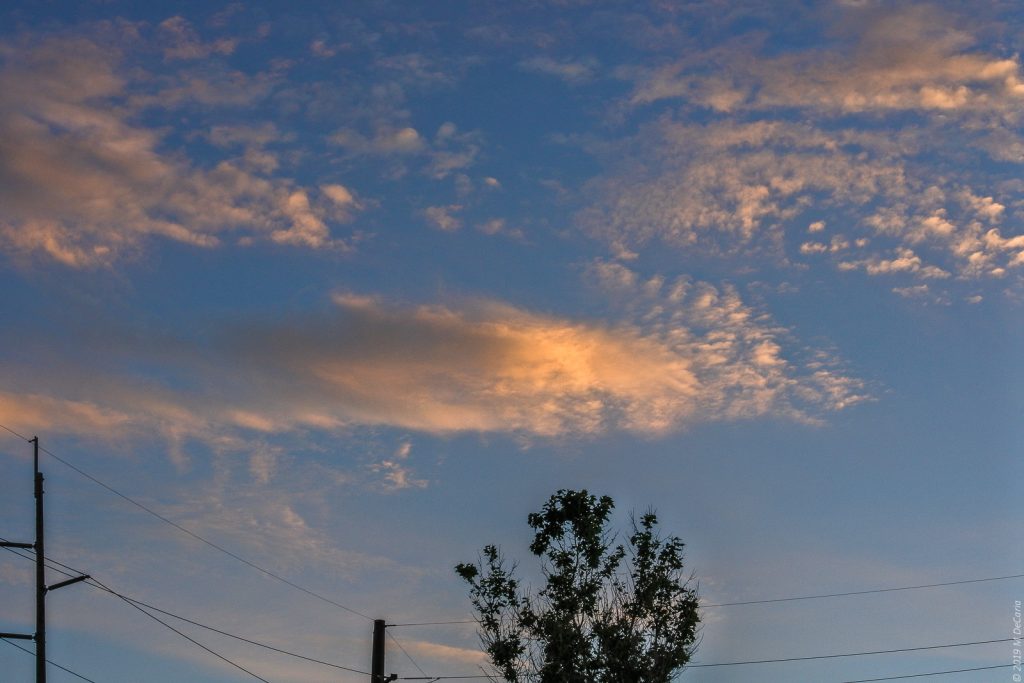
Solstice Sunrise Clouds
6:00 AM MDT. As I looked around, this altocumulus cloud formation wowed me. The clouds are illuminated from below and are due north of my shooting location. Notice the ice crystals precipitating from the left edge of the cloud. Also, note the utility poles and wires. I know that some may object to human made objects in in the quest for nature photography. The unavoidable fact, noted above, is that I live in an urban/suburban area that is enmeshed in utilities. I decided long ago to make peace with them: Sometimes trying to get a vantage point that eliminates them, sometimes just trying to reduce them, and sometimes deliberately seeking them out. Further, I am fascinated by horizontality, verticality and diagonality in art. Utility poles and wires are all that. Finally, I wish to thank Dr. Alex DeCaria, professor of meteorology at Millersville University and one of my eight siblings, for two things: He taught me about clouds and he pointed out the precipitating ice in this picture.
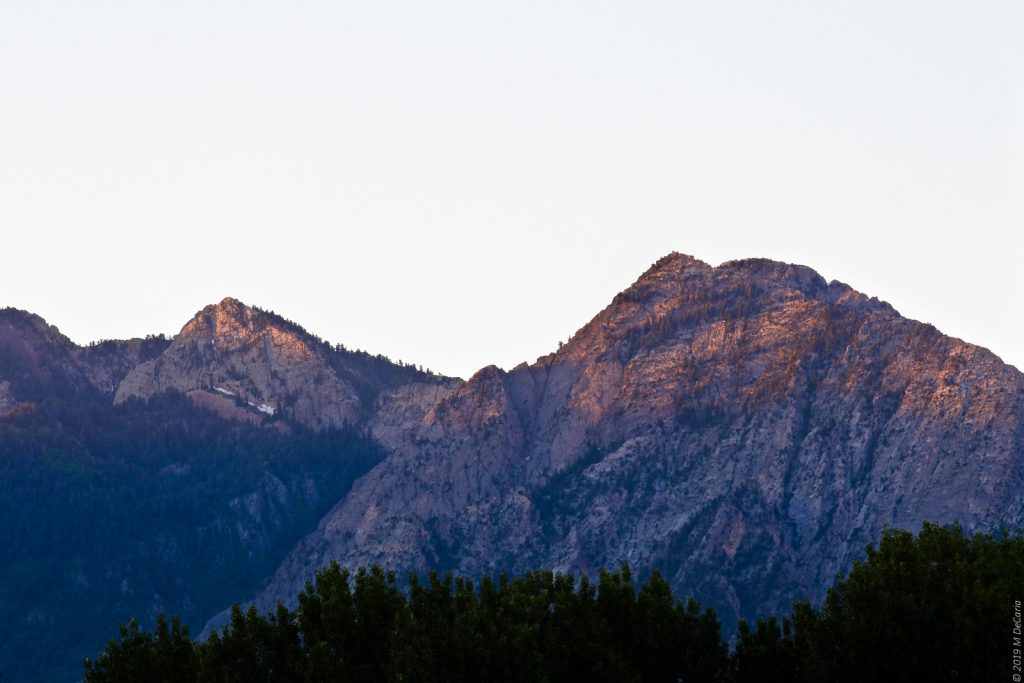
Mt. Olympus Solstice Sunrays
6:09 AM MDT. Although Millcreek Canyon and Big Cottonwood Canyon are adjacent, much ridgeline separates the mouth of Millcreek Canyon (the slash visible on the left) on the north from that of Big Cottonwood on the south. Therefore, Mt. Olympus lying equidistant between the mouths of the two canyons does not sit close enough to either canyon to serve as a sentinel. From this vantage point Mt. Olympus seems to have only one peak, but, if one travels from just a few miles south to Murray and Taylorsville, the twin peaks become strikingly apparent. I have learned long ago that mountains are shy and not photogenic by themselves. They like to play peek-a-boo through clouds, foreground trees or structures whether viewed from the city or the country. This naked photo works, however, and we are privileged to commune with the massive granite walls and their nearly vertical strata which were born eons ago as sea level sediment. They now tower at 9,030 feet/2,752 meters above sea level (ASL) and 4,800 feet/1,463 meters above the valley floor. The peace this photo conveys makes it my favorite of this gallery, although it may not be the most attention grabbing.

Wasatch Ridge Solstice Sunrise
6:12 AM MDT. This is the ridgeline somewhere between the mouths of the Cottonwood Canyons (Big and Little). The north facing flank (just left of center) now receiving the full solstice sunlight contrasts attractively with the west facing fields awaiting their turn.
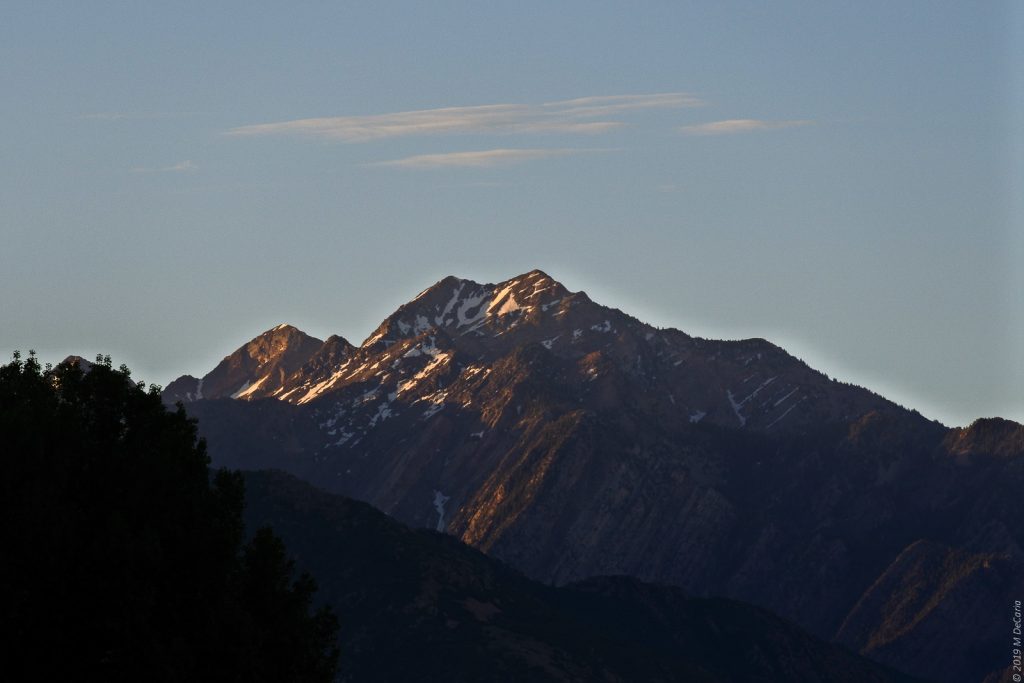
Twin Peaks-Summer Solstice Early Morning #1
6:23 AM MDT. Twin Peaks and Sunrise Peak 28 minutes after the first image in this post. Note the thin deck of altostratus clouds which has developed during these few minutes after sunrise. Presumably the warming rays of the sun on the eastern flank of the Wasatch lifted some air which cooled and produced these clouds. At the far left of the photo Dromedary Peak is hidden behind the top of a foreground tree. Watch for it in the next photo.

Twin Peaks-Summer Solstice Early Morning #2
6:27 AM MDT. Four minutes elapsed between this photo and the one immediately above. Plus, I had moved the vantage point just a bit. Now the third summit to which I alluded to just before, Dromedary Peak at 11,107 feet/3385 meters makes its appearance right of center. Foreground objects providing a visual gateway to background objects are often cliché but not here. The branches and leaves hanging from the top of the photo are interesting on their own and could have constituted their own photo. Further, they are striking because they are sharply focused and the background peaks are not. I have observed that some works of fine art offer two distinct areas with distinct moods and each enhances the other, just as sweet and sour do on the palate. The best example I can think of at the moment is Van Gogh’s Starry Night with the wonderful energy in the sky contrasting with the serenity of the sleeping village while the tree on the left in that painting links them together.
Final Notes:
- The lot from where I captured these images is now the new home of Salt Lake City Fire Department #3.
- These images certainly reflect the low contrast and low dynamic range of dawn photography. I deliberately chose not to jazz up the photos so that I could portray as accurately as possible the serenity of the early solstice morning.
- Three of the photos have blank skies. Ansel Adams cautioned against photographing on “bald-headed days”: those that have no clouds at all and those that are completely overcast. I argue that the blank skies in this post serve to focus attention on the magnificent, sleepy mountains waking up from the night and getting ready for the wild ride of long, warm days.