


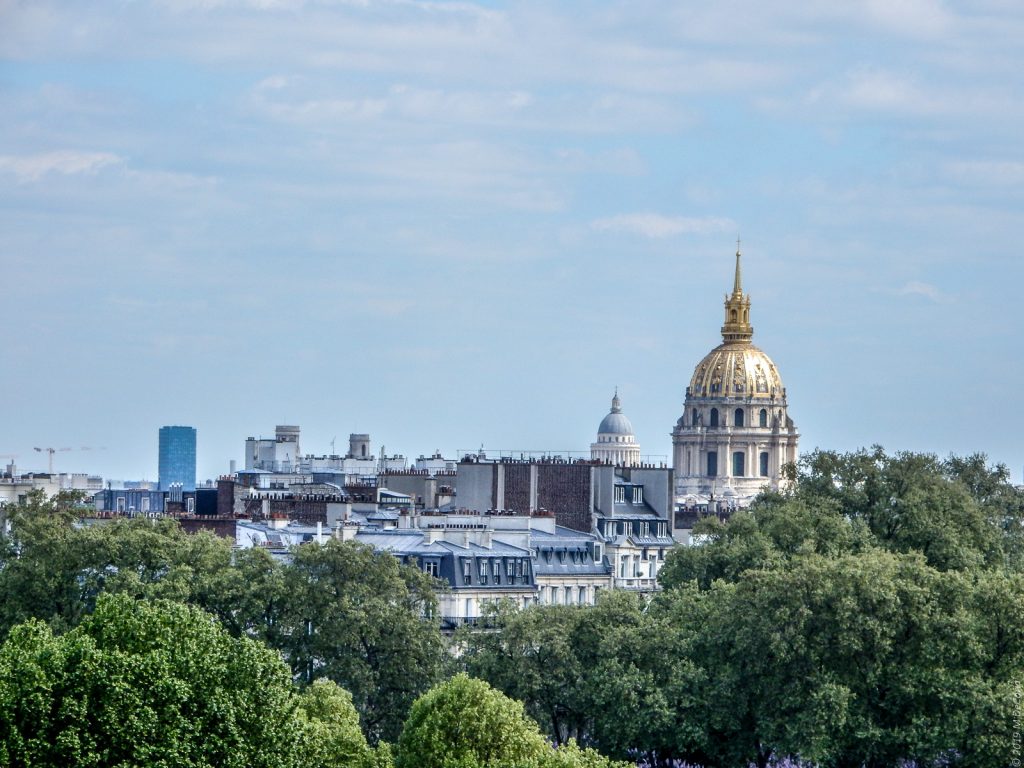
Two Domes in Paris
This photo evokes a typical view of Paris with two of its domes. The golden one is the Dôme de Invalides. and the smaller one is the Institut de France. an intellectual center of France. The domes and their accompanying complexes of buildings and academies are complex, the knowledge of which would indicate a mastery of French history and culture. I am not at that level. I must confess that I am enthralled by this scene which violates some rules of scenic photography. The sky is “baldheaded” and the elements range from nature to magnificent architecture to ordinary urbanity, but this is Paris.
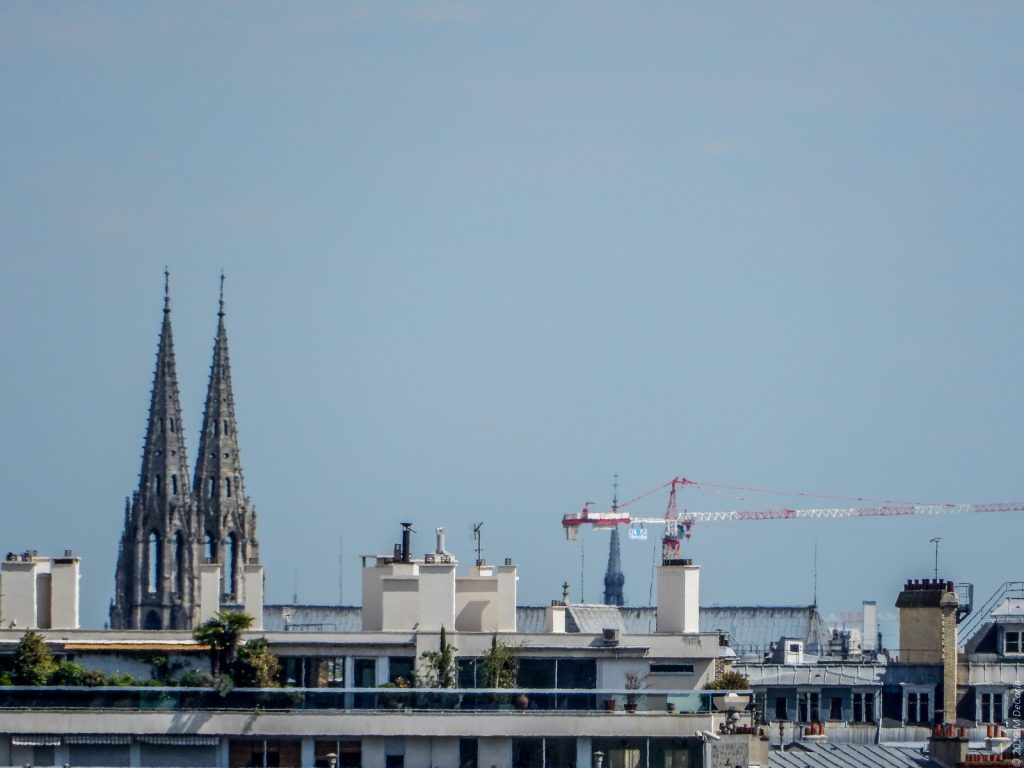
The Twin Spires of the Basilica of Sainte-Clotilde
I could not resist the contrast of this 19th century gothic style basilica with the 20th century rooftops and the 21st century crane. As a bonus the 13th-century spire of Notre-Dame is right of center behind the crane. (Update 17 Apr 2019: Since the fire of 15 Apr 2019 I have learned that the spire of Notre-Dame was a 19th century restoration of the original 13th century spire. Sadly of course, the fire has now toppled the “new” spire.)

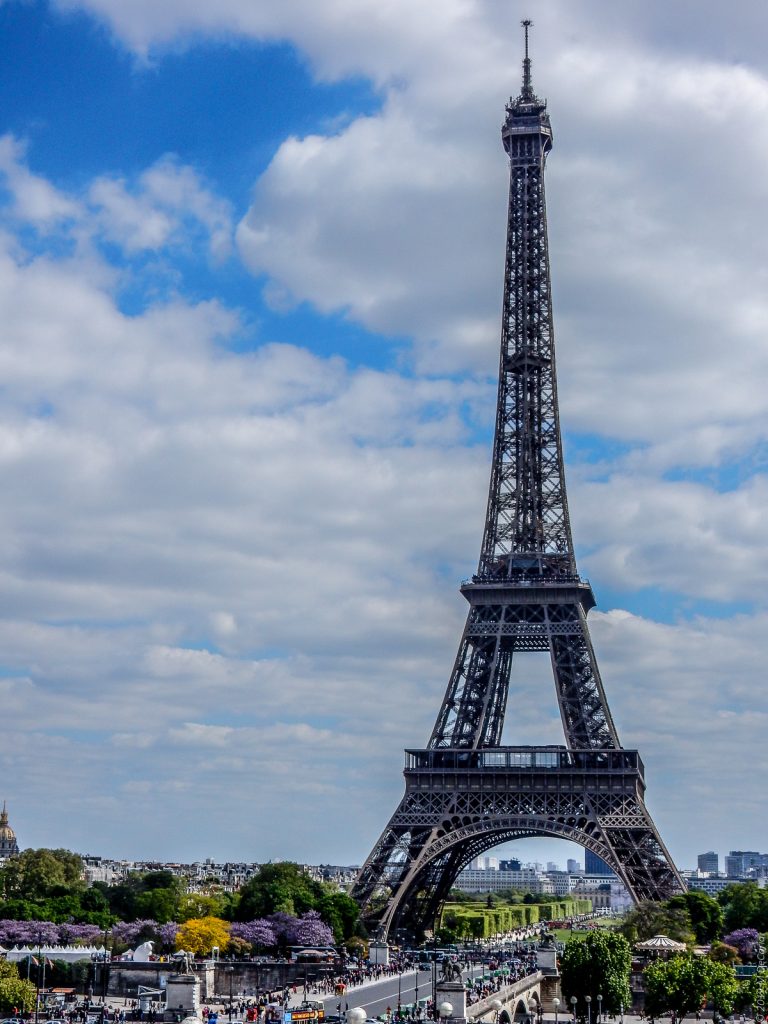
La tour Eiffel #1
Awe is relatively easy to come by in nature and relatively difficult to experience in a city. My first conscious awareness of la tour goes back to 1965 while studying college French. Over the years I have practiced the French pronunciation of “r” with this phrase. As much as I love the English language and particularly American English, the words Eiffel Tower do not capture the essence of La tour Eiffel uttered by a Parisian. I was not prepared for the overwhelming size of this structure on this 2017 trip to Paris, my first. The broadness of its base impressed me even more that its height, and its height is remarkable. In addition, I sensed its crushing mass. La tour Eiffel dwarfs everything around it into insignificance.
For extra fun, you will notice the Dôme de Invalides on the far left. The
Dôme at roughly 83 stories high is actually the tallest structure in downtown Paris. La tour Eiffel is roughly 81 stories.
You have already noticed that the tagline of this site and all my posts so far have included the word “awe.” As a psychologist I am currently devouring the research illuminating the healing power of awe. For now I will leave you with this: Awe is the emotional process of encountering stimuli so overwhelming that they challenge our existential definitions of self and of the world (cosmos) and then cause us to amend those definitions. In an upcoming mission statement for this blog, I will discuss awe in more detail.

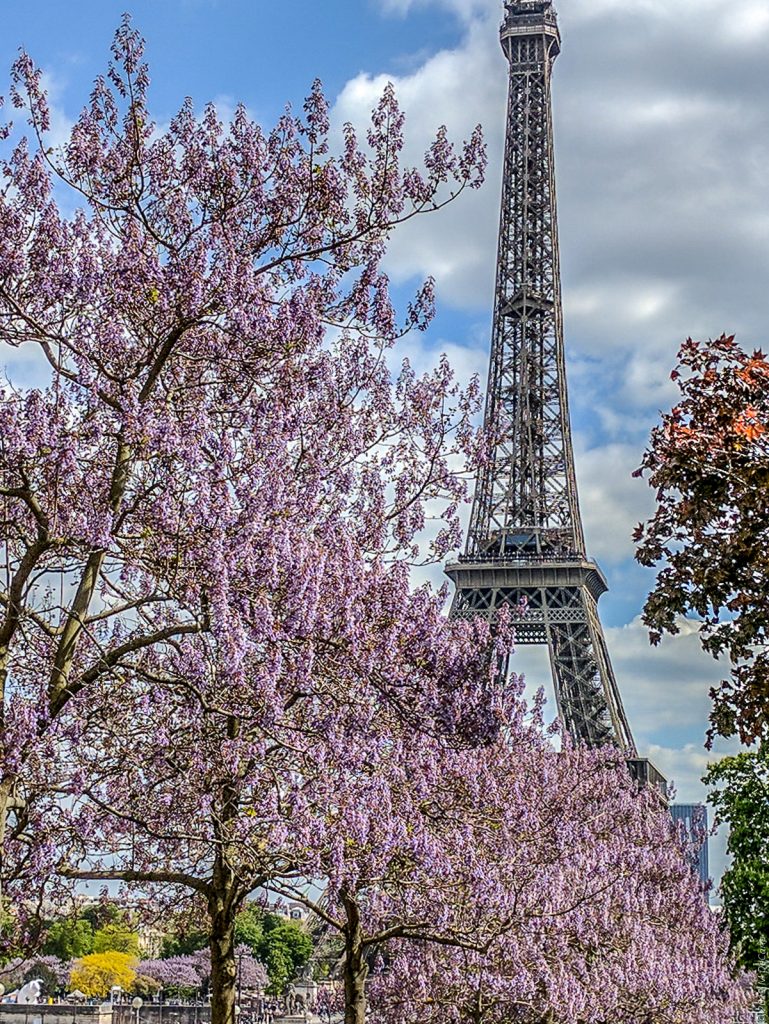
La tour Eiffel #2
Here on the Champs de Mars, Carol, my spouse, caught this image of April in Paris – minus the romantic elements of nascent love on a rainy evening. At least the setting is the La Rive Gauche (the Left Bank) but only barely.
Notre-Dame de Paris #1
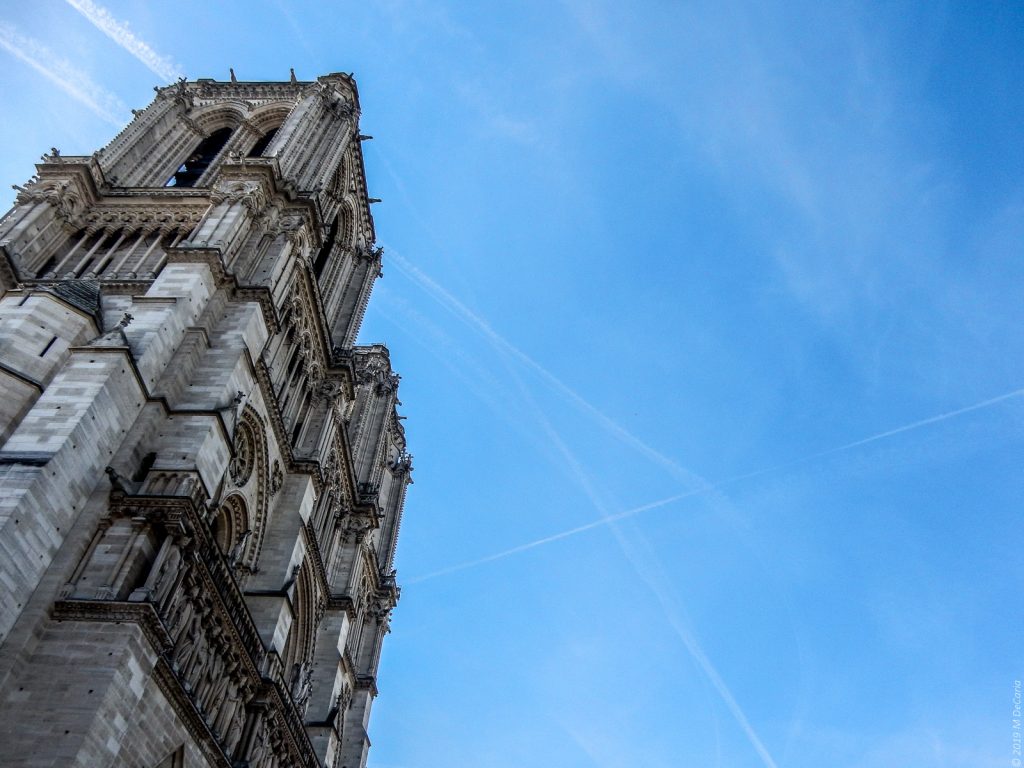
This magnificent cathedral was completed in 1260. I am enthralled by cameras because they see things I don’t think about, sometimes with good results. I was attempting to take a picture of this then 757-year-old landmark that would not end up as a tourist snapshot. I thought I would shoot upwards on one of the towers for a unique view. Only on development did I notice the ethereal cirrus clouds and contrails contrasting with the massive, ornate stonework. I like that sky covers more area than the tower.

Notre-Dame de Paris #2
I feel a strong sense of awe and other connection with the people of the 12th and 13th centuries who brought The Last Judgment to life.

Notre-Dame de Paris #3
Some of the rib buttresses which keep the weight of the roof from exploding the walls of the cathedral outward. Aesthetically, the repeating lines, the light and the stones demand to be made into an image.
French State Police Headquarters (Garde de Paris) #1
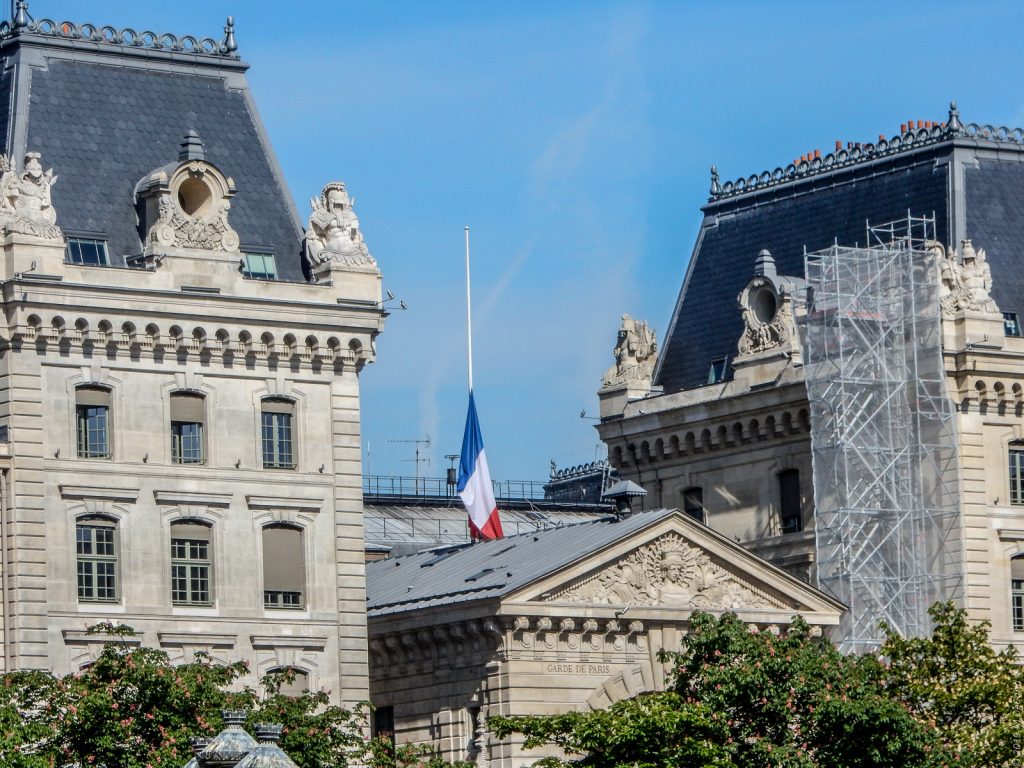
This building is “across the street” from Notre-Dame. The French tricolor is at half mast to honor a police officer killed when a terrorist had ambushed a police van four days earlier. The Champs-Élysées had been the scene of the attack. Our group had heard of the incident while on our way to dinner at a local pub in London. I experienced some anxiety because I knew we would soon be in Paris. However, during our four days in Paris, I would have never known about the attack except for seeing this flag. Just before taking this photo, I had walked by the front entrance of the police headquarters. The entrance is hidden by the trees on the lower right. The entrance was guarded by two heavily armed police officers in black. I had walked just a few meters/yards from them. I hurried along to avoid interfering with their watchfulness, but I felt a sense of sadness and camaraderie with them. My fellow passersby and I were people they were protecting rather than potential bad guys. It still gives me warm feeling.
French State Police Headquarters (Garde de Paris) #2
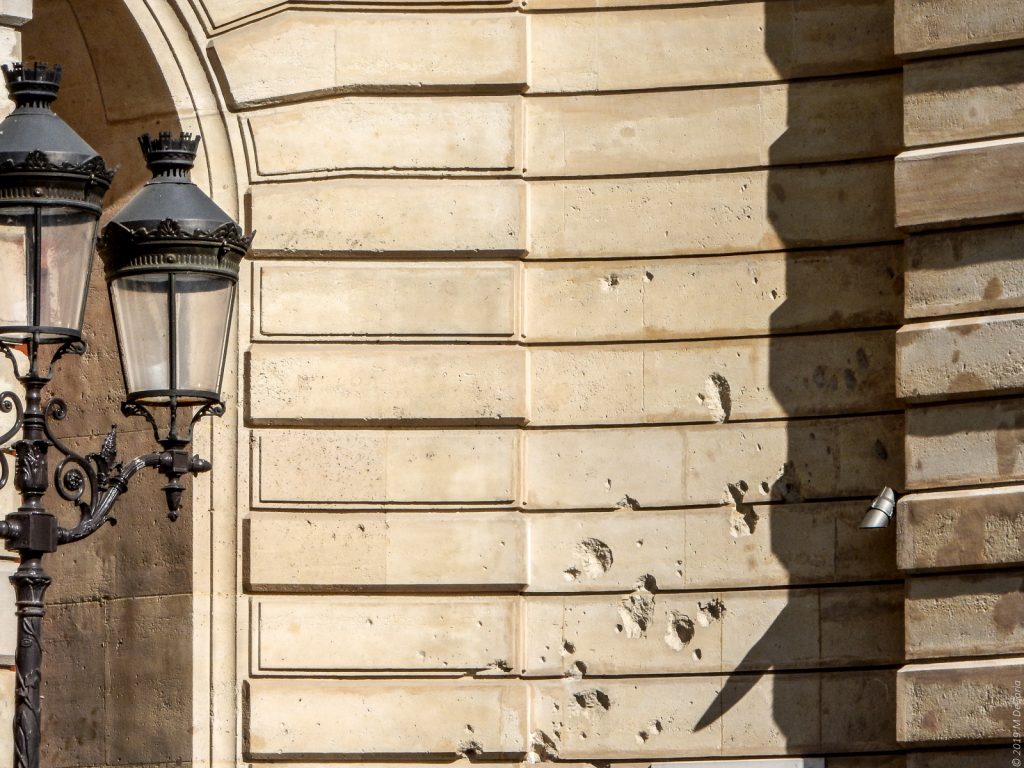
Remnants of bullet holes left by French partisans who attacked this building during the liberation of Paris in late August 1944. This is the doorway which is covered by trees in the previous image. The Germans had taken over the building for their own purposes in 1940. I also have similar photos of bullet holes in stuccoed buildings which I had taken in Grenada, Nicaragua in 2011. Of course, those were left over from the Nicaraguan Revolution during the 1980’s. I don’t think that I will ever do a photo gallery of bullet holes in buildings.

Arc de Triomphe
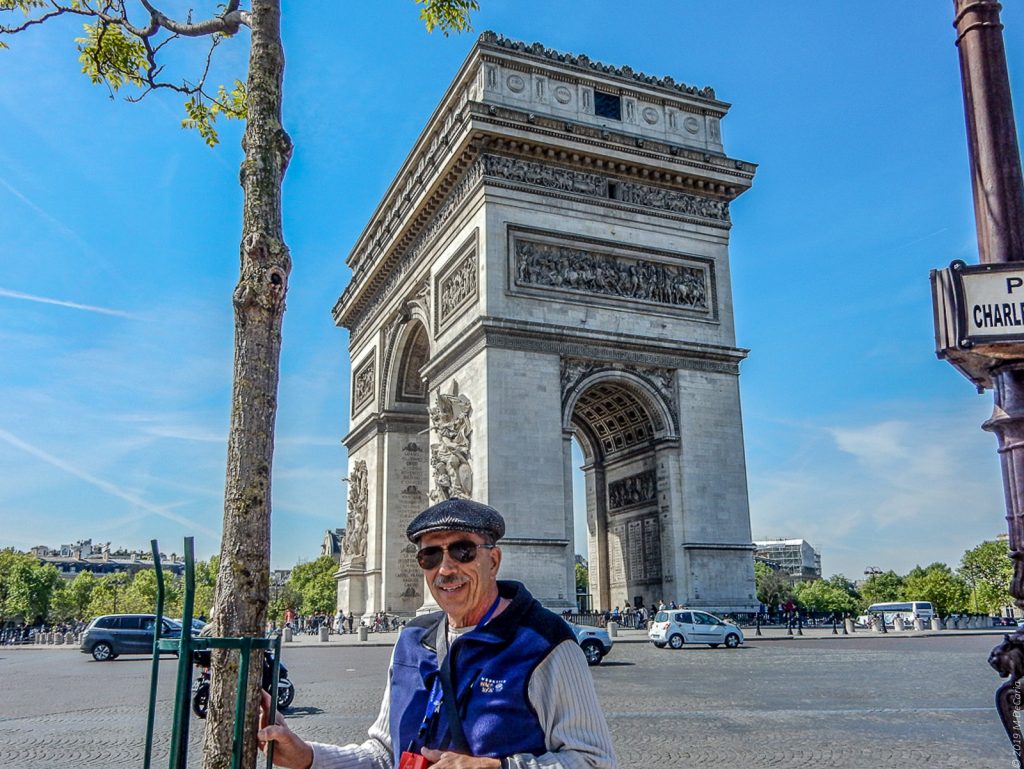
Warning: Tourist photo of me! Please bear with me because I include this photo only as a prelude to a story. Before I tell the story, this photo does not do the Place de Charles de Gaulle justice. Twelve broad avenues including the Champs-Élysées intersect here with the arch in the center. No painted lines on the immense circular slab of pavement guide traffic. Although this scene looks serene, it is not. Traffic and horns are overwhelming. It is not for the faint of heart. My spouse told that she observed a collision while we were here.
Now the story: Our guide appeared to be in her early 40’s. She told us that she lived in a 450-square-foot flat (she said “square foot”) with her teenage son. I know her first name from our tour director; but, because I know how jealousy Parisians guard any identifying information, I will not mention it. As our guide narrated our sightseeing in Paris, one of the stories she told in vivid detail was the Liberation of Paris in 1944. She told of us about General Charles de Gaulle leading the Free French into the city including here at the Arc de Triomphe. What impressed me is that she narrated the events as if she had been an eye witness, although it was 30 years before she was born. In 2015 the French government awarded my father the Legion of Honor, for service in WWII that contributed to the liberation of France. My father was a B-24 top gunner/flight engineer who flew 30 missions from England over occupied France and Germany from June to December 1944. Nine of those missions were in support of the battles of D Day, Normandy and Northern France. At this photo stop at the Place de Charles de Gaulle, I screwed up my courage and took our guide aside to tell her that my father was a knight in the Legion of Honor. She immediately teared up and embraced me for an extended time. She told me that the hug was for my father, and I was to give it him upon my return to Utah. She then asked for my email address. Knowing the culturally driven privacy of Parisians as noted above, I was surprised. To my disappointment she never did contact me.
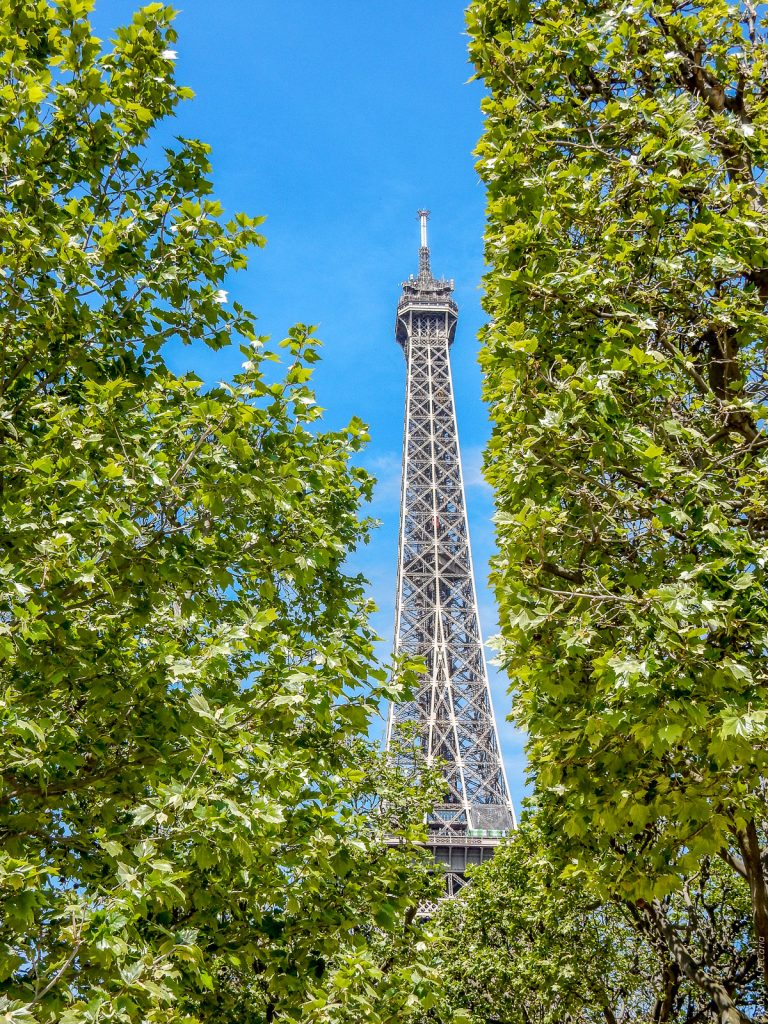
La tour Eiffel #3
Notice that the inside edge of the tree on the right curves with the tower.
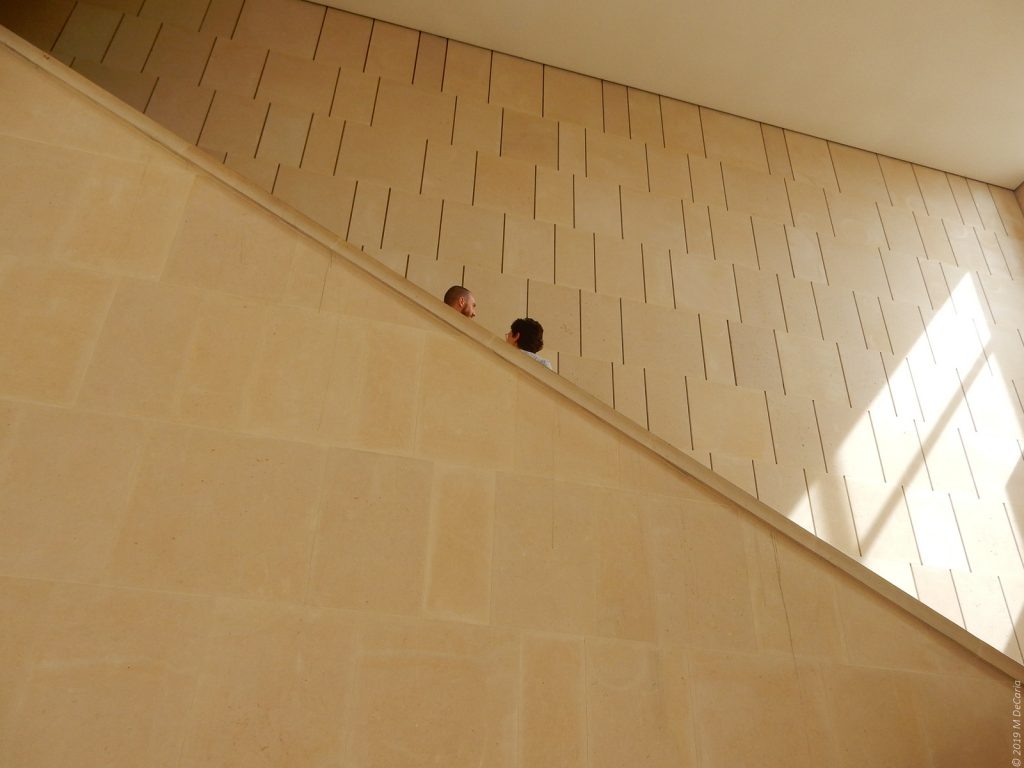
Front Gallery of the Louvre*
Although I had wanted to visit Paris for 50 years, the two proverbial straws that broke the camel’s back were: 1) the famed historian David McCullough’s The Greater Journey: Americans in Paris and 2) Leonardo da Vinci’s Mona Lisa. From the 1820’s to the American Civil War, living in Paris served as an almost essential experience of young Americans who had wealth or wealthy parents. The list of these Americans is long and include people who went on to make names in art, law, medicine and science through the remainder of the 19th century and their descendants into the 20th century. I would read McCullough’s book at lunchtime at my desk. While eating I would look at Paris on Google Maps and dream of standing on the Île de la Cité, an island in the middle of the Seine and home of Notre-Dame. McCullough devotes a fair portion of his book to Samuel Morse and his daily toil in the Louvre as he paintedThe Gallery of the Louvre. On a giant canvas Morse reproduced miniatures of roughly 35 works of art, mostly paintings. His goal was to acquaint the newly born America with the rich heritage of European art.
Separately, since my days of growing up Italian and Catholic in a small Mormon town in northern Utah which had neither Italians or Catholics, I looked to Italian culture to have pride in my roots. Of course, the most famous painting in the world was Mona Lisa and I always wanted to experience it. McCullough’s book and Morse’s inclusion of Mona Lisa in The Gallery cemented my desire to see La Gioconda in person.
I did manage to communicate with the Mona Lisa in person, and the awe sticks with me to today. The process was difficult because she was surrounded by crowds of people taking selfies with her. I did not take a photo of the painting, selfie or otherwise, because the awe of certain subjects is impossible to convey in reproductions.
*This photo was not posed and I do not know the two people. I just happened to find the two heads in the center of this composition and took a shot.
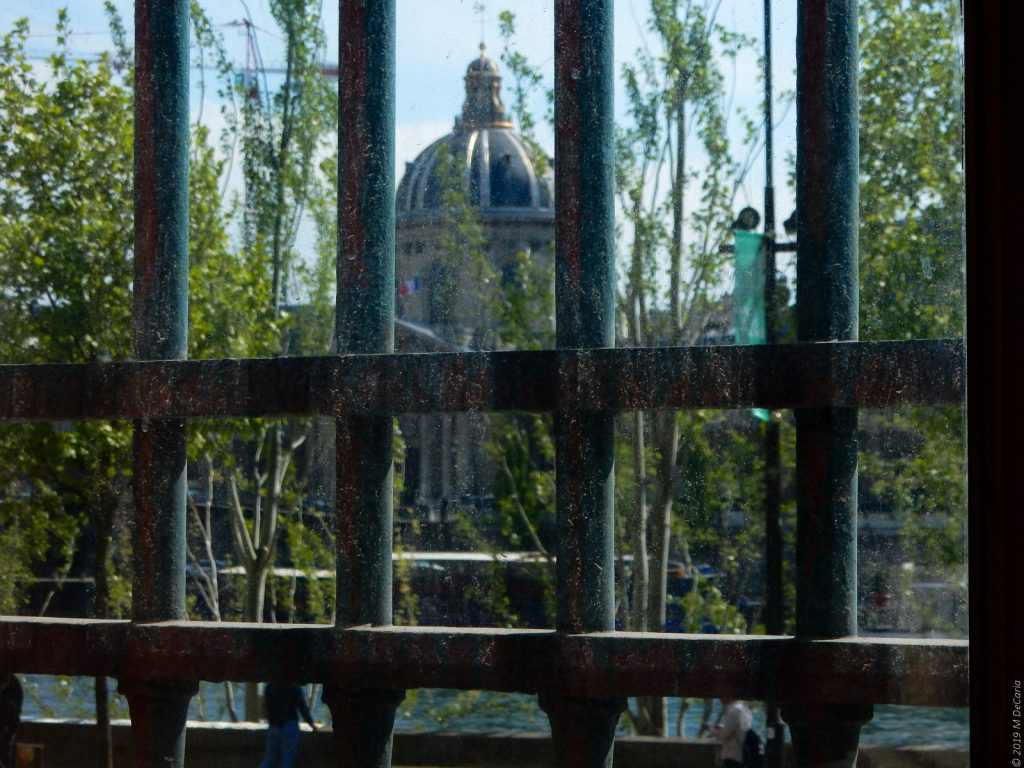
Institut de France
From inside the Louvre. Among other prestigious entities, the Académie francaise maintains its headquarters here. (Please also see the first photo above.) I utterly respect that Parisians are proud of their language including its pronunciation, but they do change French in keeping with the times. Even an outsider like me can see that the Académie is an ossified institution more interested in the personal privilege of its members than in the vitality of the French-speaking community. It cannot be overstated how out of step the Académie is with 21st-century French.
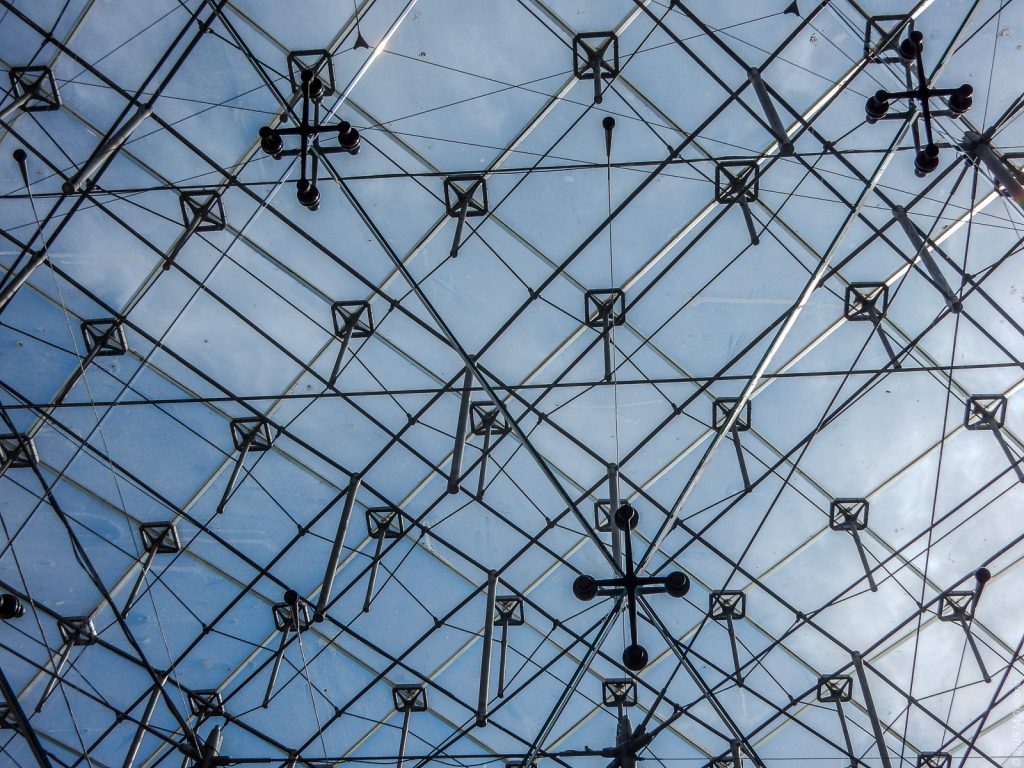
Pyramid of the Louvre
From the gallery of the Louvre looking up through I. M. Pei’s glass pyramid which marks the entrance to the Louvre.
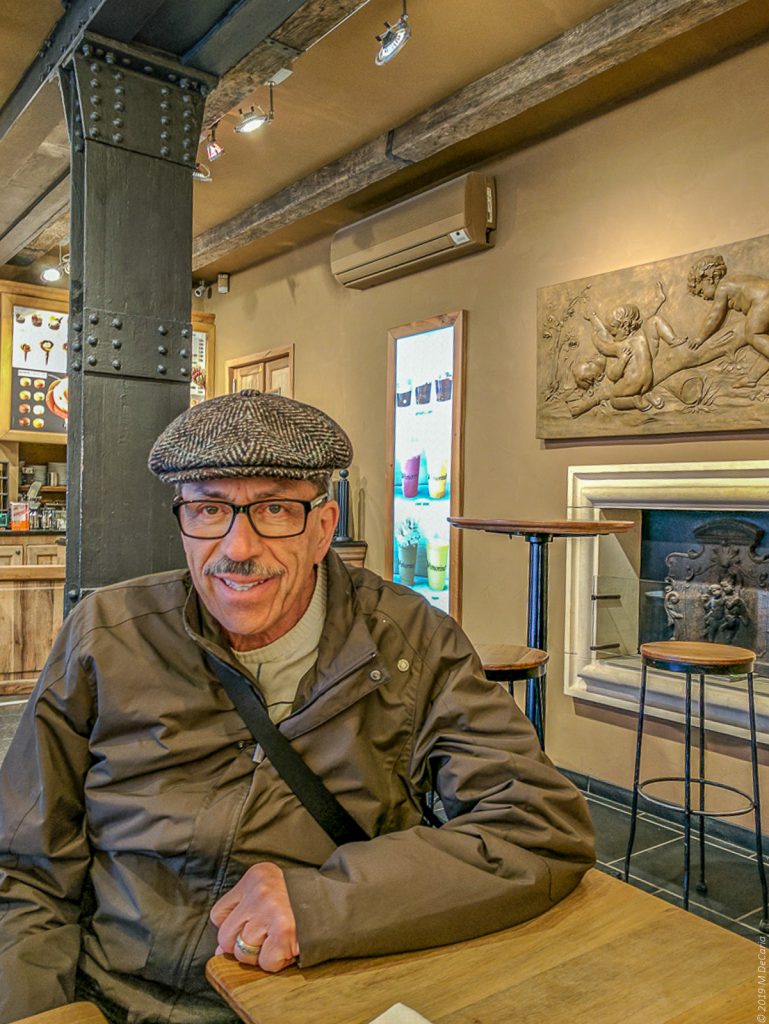
Cafe near the Luxembourg Gardens
My spouse took this photo of me as were drinking coffee and eating macarons in this delightful shop off the beaten path in the Latin Quarter. It was a gray rainy day, and we were excited to find this indoor spot of sunshine.

Pastry Shop Window in the Latin Quarter
I was charmed by this shop window. Like most people I love French pastries and have even taught classes in the subject. I once catered several dozen macarons for a young bride’s wedding. She had taken my macarons class specifically after visiting Paris herself. Between my psychology practice and now blogging, I no longer teach culinary classes. I will post a blog with macarons the next time I make them.
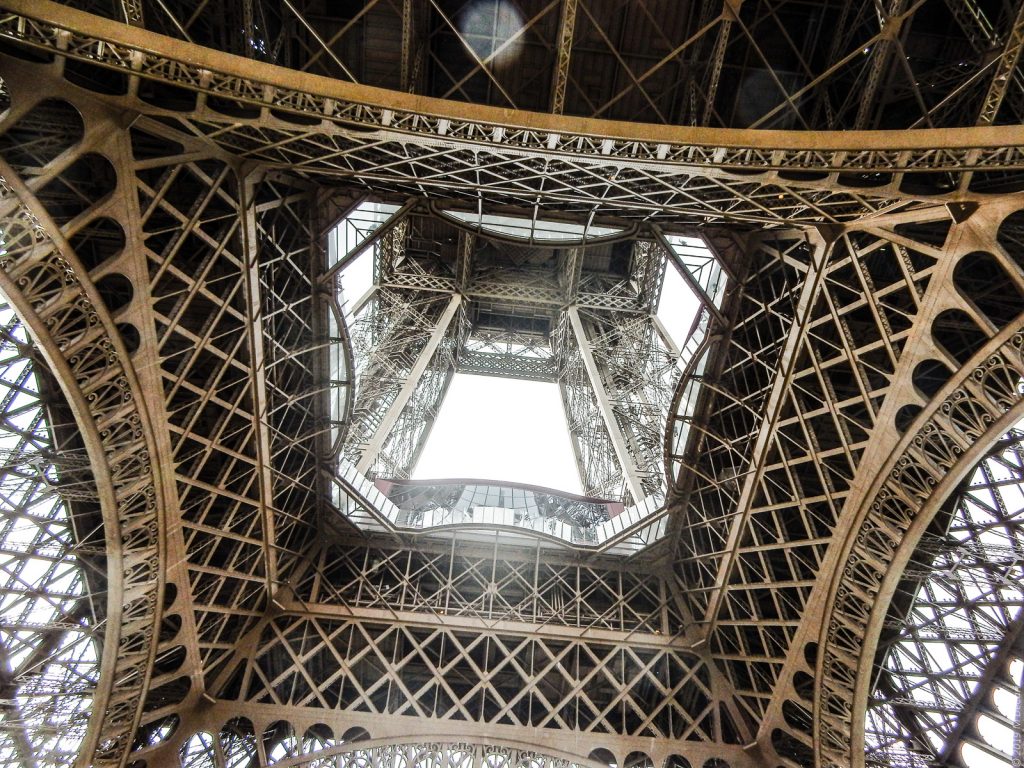
La tour Eiffel #4
On our last evening in Paris we had dinner at a restaurant in the tower. After dinner we had the run of the second and third levels. This is looking up from the second level.

La tour Eiffel #5
The tower is not visible because I am standing on an upper level and looking out. By now you can recognize the Dômes de Invalides on the right and Notre-Dame in left distance. This photo was just at sunset.
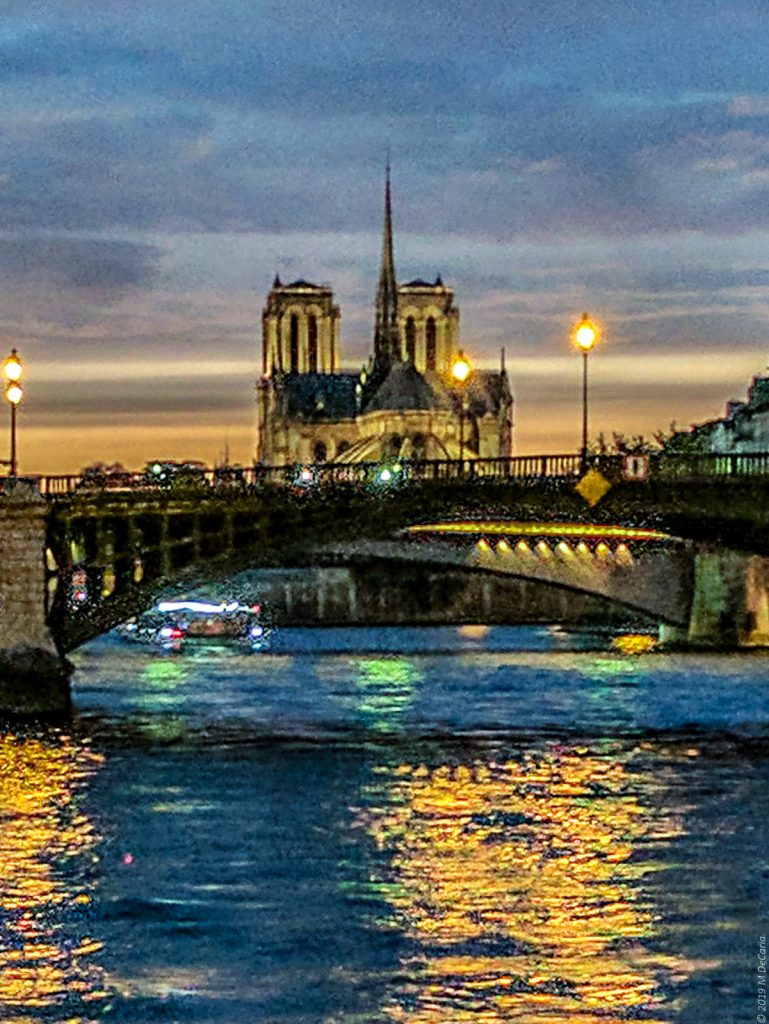
Notre-Dame from a boat on the Seine
This highly pixelated photo is as close to French impressionism as I will ever get.