
Delta Airlines 56 from SLC to AMS
On 3 Aug 2018 Susie and Seth Jarvis along with my spouse and me flew from Salt Lake City to Amsterdam for a two-week Northern Isles Cruise aboard the ms Koningsdam of the Holland America Line. Our ports of call included two in Scotland, three in Iceland, and two in Norway with embarkation and debarkation in Amsterdam. Our overnight flight left SLC late in the afternoon. I had managed to fall asleep for a few hours and then woke up in the dead of night. Curious, I gingerly lifted the window shade from my window seat and looked out. This is the scene that greeted me. I took this photo with a Google Pixel 2 XL phone. This image can do only faint justice to the real vista. Please bear with me while I describe what the camera could not capture.
At first, I thought I was facing east and was looking at an incipient sunrise. I had seen similar views on predawn red-eyes from Anchorage to the contiguous 48 before. But thanks to the GPS nestled in the seatback in front of me, I learned that the plane was headed due east and, from my window seat on the port side, I was facing due north. And all this at 37,000 feet/11,278 meters ASL. Due north is the absolute center of the photo. Wow! This was no sunrise in the making, but instead I was witnessing the edge of night, the midnight sun beyond the horizon. We were approximately 2,192 miles/3,527 kilometers from the north pole, 90 degrees north. The sunlight was reaching from the opposite side of the planet, over the pole and all the way down to latitude 70 degrees north on my side, which was 1,370 miles/2,204 kilometers from the plane’s position at 58 degrees north.
The next shocker was the noctilucent clouds. These ethereal threads of luminescence are unforgettable. Noctilucent clouds live at approximately 50 miles/80 kilometers ASL, far higher than everyday clouds whose tops rarely extend to 9.5 miles/15.3 kilometers ASL.
Even though the sun is below the horizon on the other side of the North Pole, its light is evident in illuminating the noctilucent clouds. Further, you can see that the light is brightest just a few degrees east of north. In this photo taken just minutes after local midnight, you can deduce where the sun is below the horizon. The wing is hiding the due north where the red band is brightest and revealing the location of the Sun below the horizon.
The exact position of the airplane as I took this photo was 58.030 degrees north and 30.836 degrees west, over the North Atlantic Ocean. The horizon on the extreme left and visible just behind the wing is a portion of the Greenland coast about 550 miles/882 kilometers distant. On the extreme right some mountains of Iceland are visible about 377 miles/606 kilometers distant. Only fata morgana conditions on that clear Arctic morning could account for such visibility.
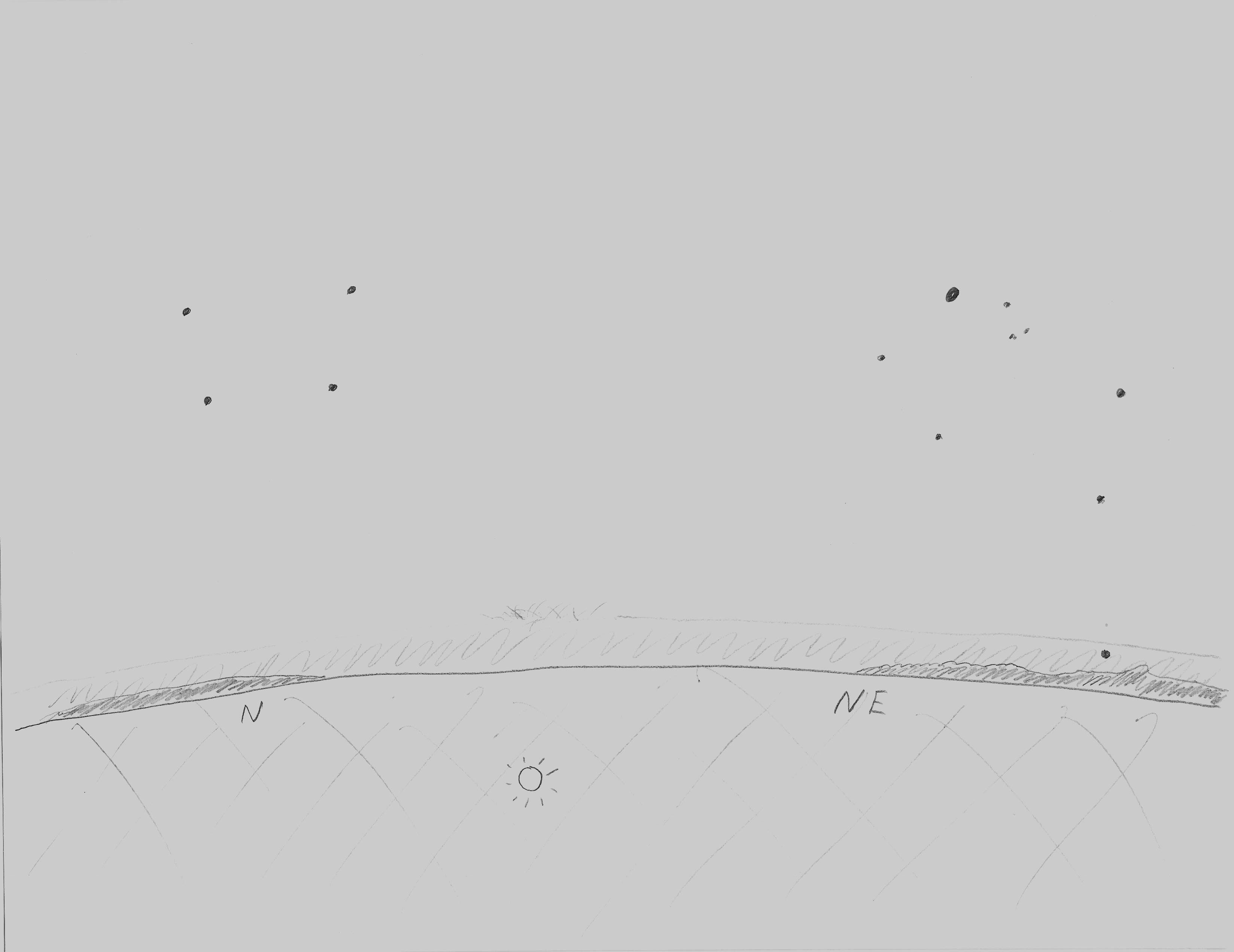
Sketch of the View of the Photo Above
The curved line at the bottom of the sketch is the horizon. I have indicated the position of the Sun below the horizon. Although the Sun is not directly visible, its light is betrayed both by the coppery band along the horizon and by the reflection off the noctilucent clouds. That coppery band did glow the brightest directly above the sun’s position. The darkened mass to the right is Greenland and the one to the right is Iceland.
The color of the sky was absolutely remarkable. It was a mixture of the the deepest black I have ever seen along with a touch of barely perceptible navy blue. The bowl of the Big Dipper asterism was visible to the right and the pentagram of the Auriga, the Charioteer, to the left. The bottom left star of Auriga’s pentagram doubles as the tip of one horn of Taurus, the Bull. The tip of the other horn shone brightly just above the horizon over Iceland. I had to put my face directly on the glass and strain to the right in order to see Auriga. Notice the bright star Capella, the she goat, and her three kids in the upper right of the sketch.

North Sea Canal
The North Sea Canal stretches west from Amsterdam to the North Sea. This view of the Dutch countryside looks directly north from the top deck of the Koningsdam. The first evening of a cruise is a magical time and some of the most memorable photos are taken on those first evenings.
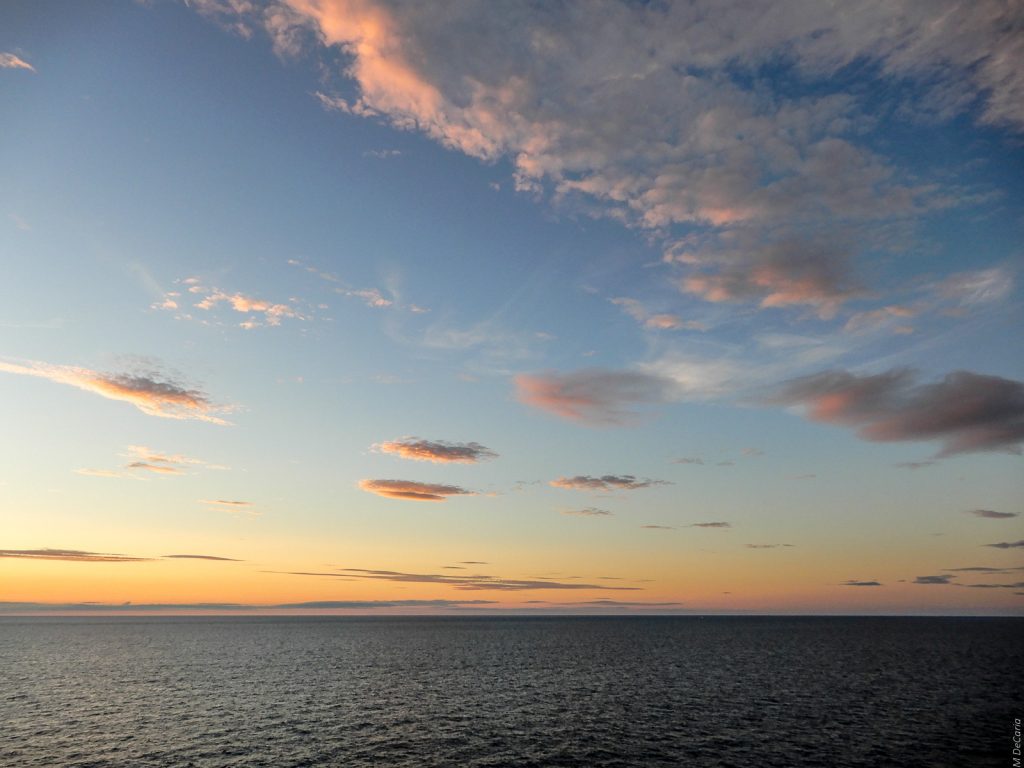
The North Sea
Another first evening photo. Although I had flown over the North Sea before, this was my first time on it. The Koningsdam had just emerged from the North Sea Canal and was heading for Edinburgh. The North Sea has loomed large my in mind since early childhood when I had learned that my father had flown 30 B-24 bombing missions over it. Those WWII missions started from Bungay in East Anglia and bombed military targets in occupied France and Germany. In spite of occasional flak damage and even losing power a few times in an engine, they always made it back to Bungay without a dunk in the North Sea. (Please see previous post, Questing for Wonder in Paris, Arc de Triomphe). It is all too easy to imagine this scene filled with hundreds of war planes rather than this serene sunset with its altocumulus clouds.
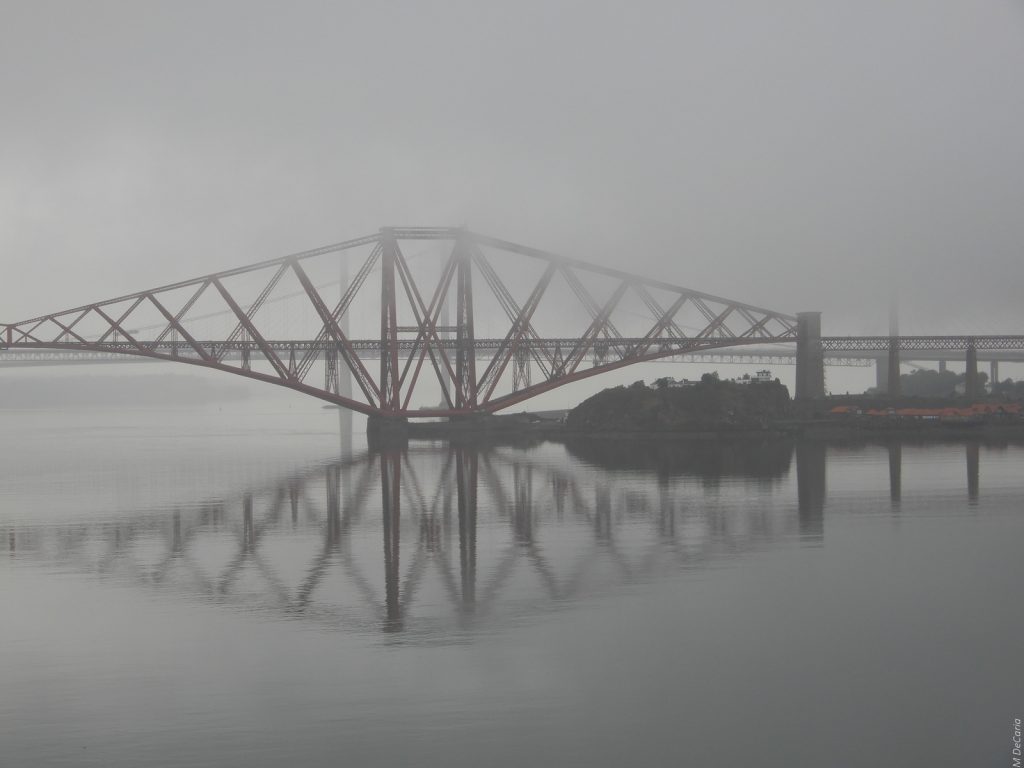
Queensferry Rail Bridge
Arrival in Edinburgh. Upon awakening early in the morning, I wandered out to the balcony of our stateroom. The ship was moored in the middle of the Firth of Forth and we were completely fogged in. The only visible object in the fog was this bridge about which I knew nothing at the time. The girder work reflecting in the water and the surrounding mist were irresistible. Best of all, I knew that this was one of those beautiful scenes that could actually be conveyed in photography. The actual color of the bridge is bright red, but any tint was barely noticeable. To my naked eye, the bridge appeared gray. Not until a few hours later in broad daylight did I see the red. Some red tint is apparent in the photo, but I swear did not see it at the time. I did attempt to render this image in black and white, but it turned out dull.

Looking Across Edinburgh from Holyrood Park
Holyrood Park is a on a hill southeast of downtown Edinburgh. I very much like the steeples and the rain. Edinburgh is a city whose beauty and charm are not obvious. The city is just wonderful in its unassuming and capable citizens, its history, and its buildings old and new. Edinburgh can only really be experienced by walking its streets with breaks for coffee and snacks in local eateries. I miss this great city and must return.

Forth Road Bridge Across the Firth of Forth
View from North Queensferry in Fife looking south to Queensferry. I found this scene compelling due to the sweeping arch of the bridge and the gorgeous grays of the sky. This photo would be just another snapshot on a blue sky day. Downtown Edinburgh is out of sight beyond the far left of this photo. Until this bridge was completed in 1964, ferries provided vehicle and pedestrian crossing. The Queensferry Crossing (Bridge) partially visible to the left was completed in August 2017 just 12 months before this image was captured. The Queensferry Rail Bridge, completed in 1890, spans the firth just beyond the right edge of the photo. The two bridges in this image appear as barely perceptible ghosts in the Queensferry Rail Bridge photo above.

The Firth of Forth Meets the North Sea
Leaving Edinburgh behind we are headed out to the North Sea and our next day’s port of call in Inverness and Invergordon in the Scottish Highlands. Please see the previous post, Questing for Wonder in the Scottish Highlands near Invergordon for an account of that day. As you can tell from this blog so far, I do admit to a fascination for clouds.
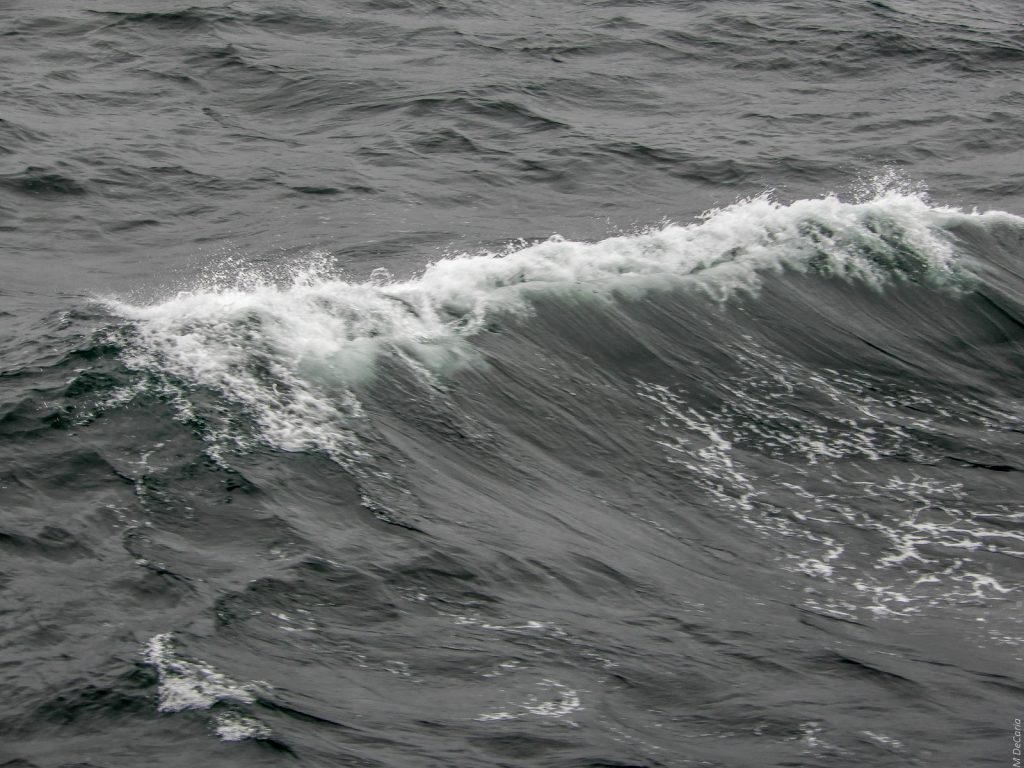
Wave on the North Atlantic
Our passage from northern Scotland to Iceland across the North Atlantic was rough. The violent motion of the ship and alarming metallic crashes of the waves on the hull made the night and the morning difficult. At times we were not allowed on open decks. I took this photo from the main deck at a time we could go out. The air was cold, fast and filled with salt spray. I had positioned myself forward on the starboard side where the sea and the vessel met. I was counting the succession of waves because every seventh wave is often the mightiest. This was one of those seventh waves just before it struck the hull. The sea was at force 8 on the 13-point Beaufort scale: waves 5.5 meters/18 feet high, wind 62 to 74 kph/39 to 46 mph, spindrift on the crests, and pronounced streaks. This was a “fresh gale” with “high to rough waves.”

Reykjavik
After a rough night and day at sea, it was a relief to reach the harbor of Reykjavik. Notice the unmistakable spire of Hallgrímskirkja, a Lutheran church. Also, notice the blue dome of the Perlan in the left rear of the cityscape. Built on the foundation of old hot water tanks, the Perlan is a museum, gift shop, and observation deck. It is a must-see experience. The clothing in the shop may seem pricey, but it is of high quality, and I urge you to buy at least one piece. Further, one must remember that Iceland is precious because it is difficult to get there. An observation about Iceland: The natural beauty of Iceland is immediately obvious no matter where you go. But the human part of Iceland, the ontological and the cultural, is subtle and must find you.

Lake Kleifarvatn in Southeast Iceland
This was a difficult shot because I facing directly into driving rain.. The wind was in excess of 65 kph/40 mph and the temperature was 6 degrees C/43 degrees F. The camera lens was covered with water and took over an hour to dry. If you look carefully, you can see the water droplets on the lens.
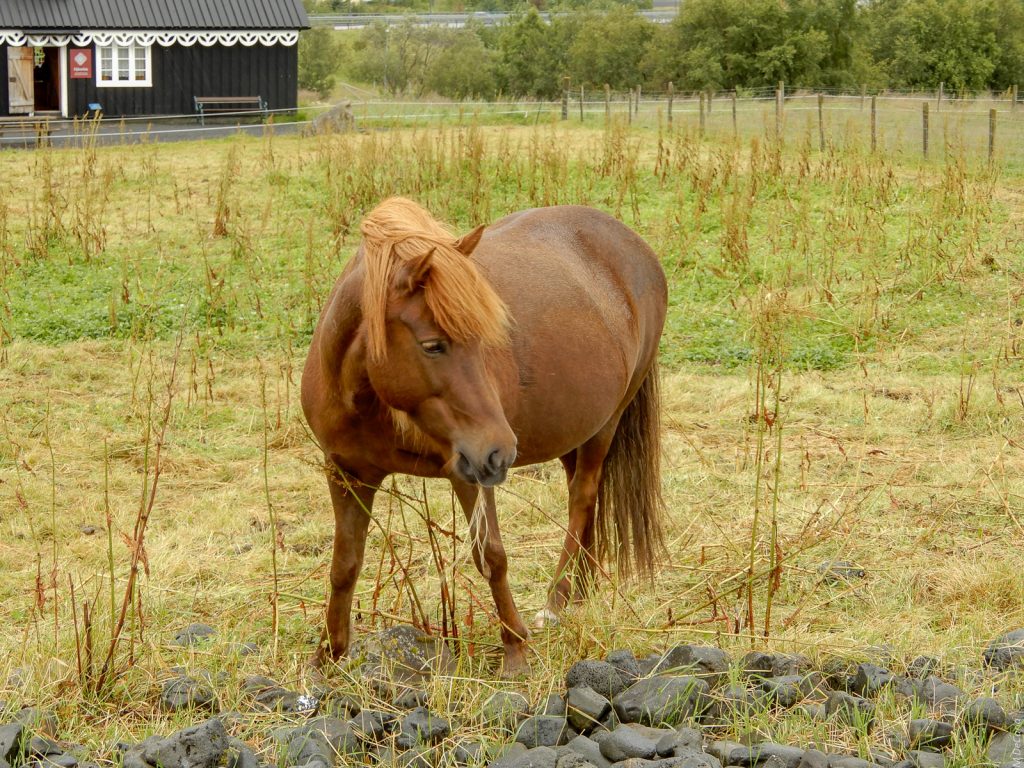
Icelandic Horse
These are amazing animals descended from the Viking horses of the late 9th century. It is said that, since that time, no horses have been imported to Iceland. If any horses are taken out of the country, they may not be brought back. This one was obviously curious and intelligent. There we were: Just the two of us all by ourselves separated by a fence. I will never forget the honor of our brief connection.
This is the last photo of Iceland for this post. I ask you, if you have not already, to visit a previous post: Questing for Wonder near Ísafjörður: The Capital of the Western Fjords of Iceland.

Alesund, Norway
An iconic warehouse on a wharf as we approach this port city with a population of 50,000. This is a typical rainy August day. Notice the gull near the top of the image.
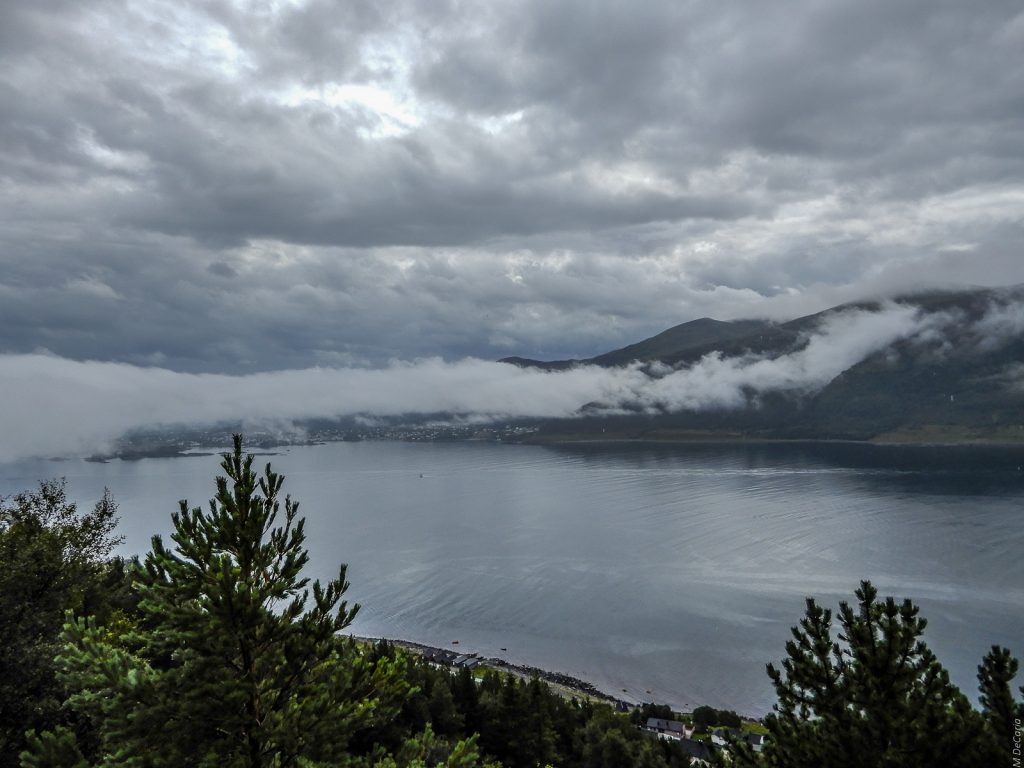
View from Sukkertoppen Mountain
The low lying stratus obscures the view of the Alesund city center.

The Trail from Sukkertoppen
Rain does not deter Norwegians from hiking. The rain rendered the clay soil and the exposed roots very slippery. At a little more than halfway up, a fellow hiker from Canada could no longer go up and was afraid to go down on her own. My spouse, Carol, in the blue poncho, and Susie Jarvis whom the tree limb is obscuring, helped our friend down the tricky descent. Frankly, because I found myself without proper hiking boots and without my trusty hiking poles, I was glad to turn around, too. More than once Carol assisted me on some especially steep descents. Due to otosclerosis, a disease process of the middle and inner ear, I experience equilibrium issues when the footing is unsure. I want another chance at Sukkertoppen with my hiking boots and poles, rain or not!

Sunset on the North Sea
Sunsets and sunrises are tricky subjects for photographers because their twice daily occurrence renders them prone to banality and because more than one half of all humans possess camera phones. Nevertheless, I openly confess to being a sunset and sunrise junkie. Therefore, I pledge to share sunrise and sunset images only when the event is extraordinary. In this shot from the starboard side, the sun is setting over the the Faroe Islands, approximately 480 km/300 miles to the west, with the coast of Norway about 80 km/50 miles to port at my back.

Bryggen in Bergen
This is the part of the dock in Bergen, Norway. Buildings have been here for centuries. Because many fires have struck Bergen over that time, it is difficult to say how old these actual structures are, anywhere from 250 to 500 years old. The steep hill behind the buildings ends up on an urban mountain peak, Mt. Fløyen.

Bergen City Center…
…as seen from Mt. Fløyen at 1000 meters/3281 feet ASL. The Bryggen in the previous image lies just beyond the right edge of this photo. I cannot help but think that this could be a 1000 piece jigsaw puzzle. I really like the unexpected chaos that results from the rectilinear architecture. As for the colors, white paint is the most expensive with red the least. Yellow paint is in the middle. Seth Jarvis, the director of the Clark Planetarium in Salt Lake City, whom I mentioned in the first sentence of this blog, explained to us the astrophysical reason for the gradation of the expense. Stellar furnaces make more iron, the red, than they do cadmium, the yellow, and in turn zinc, the white. The Earth, a product of previous generations of stars, therefore has more iron than cadmium, and more cadmium than zinc.
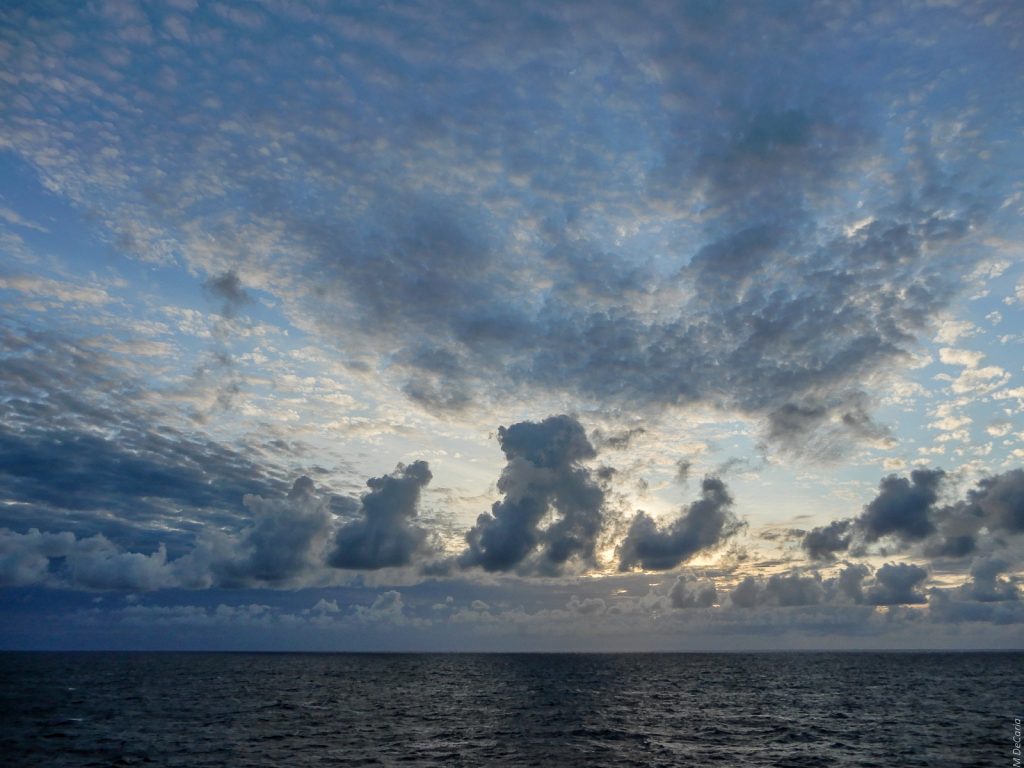
On the North Sea Between Bergen and Amsterdam
I never tire of the dimensionality of clouds over seascapes.

Good-bye to the North Sea
I unapologetically offer one last sunset on the North Sea. Sadly, the next morning we disembarked at Amsterdam.

Another beautiful post! I found the explanation of the fata morganna conditions to be fascinating. The pencil sketch was simple but a clear explanation of the view. One of my favorites, the black and white image of the Queensferry Bridge, had a quiet but beautiful appeal.
The Firth of Fourth meets the North Sea was a gorgeous study in blue. I remember standing on the deck of our ship inhaling the crisp, clean air and studying the vastness of the horizon. This image captures it all.
The sunset on the North Sea was stunning!! Did you use a filter?
This post brings back many memories of our trip. Thanks for sharing it!
The image of the Queensferry Bridge was an extremely lucky shot. We had just anchored in the fog, and I looked up to see this bridge and nothing else. All I had to do was frame the scene and push the shutter. Further, there was nothing to do in Lightroom. The image was shot in color but the scene was naturally monochromatic. Again, I did not touch a single slider in Lightroom; the Nikon engineers deserve the credit. Similarly for the Sunset on the North Sea. I did use the sunset selector in the scene program of the camera, but again hats off to the Nikon engineers. So, no filter and those are the Earth’s own colors. That the vivid colors are reflected in the sea is truly extraordinary. Please refer to my “Solstice Sunrise” for more of my thinking about sunrises and sunsets. Thank you so much your comments!