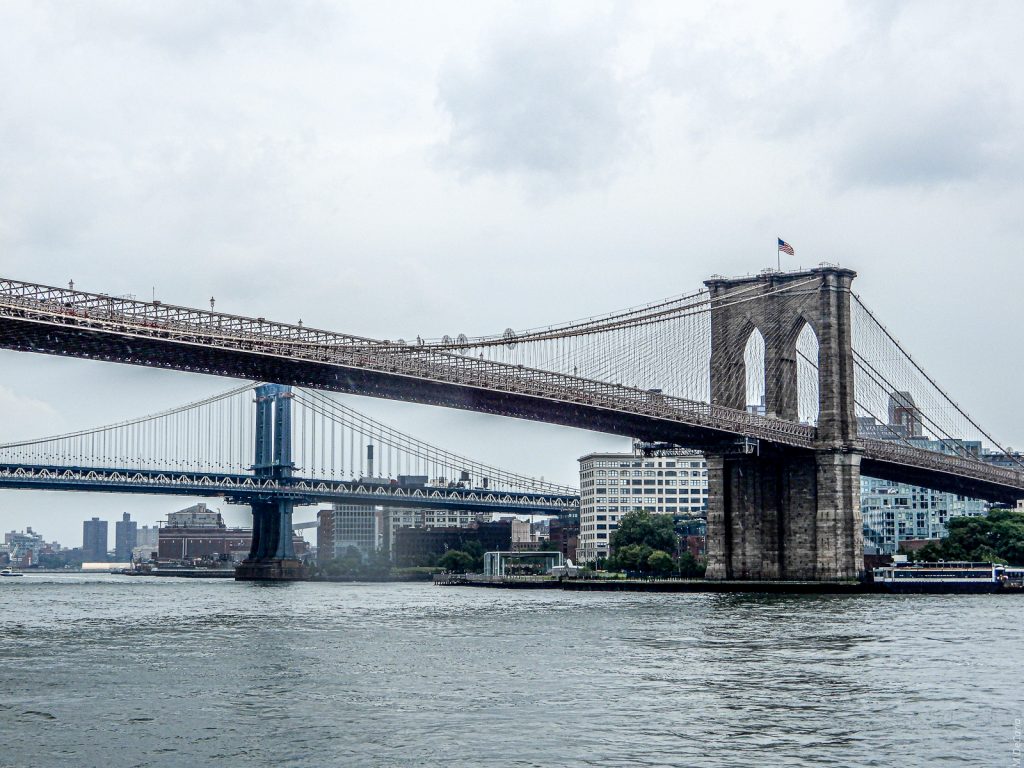
Brooklyn and Manhattan Bridges
In August 2019 Carol and I spent three days in New York City before embarking on a nine-day eastern Caribbean cruise. Our original plan for this particular day, an urban hike from Battery Park to the West Village and back, faced intermittent rain. We salvaged the day by riding boats around New York Bay and found cover below decks or under umbrellas as needed.
In the above scene we had just departed Pier 16 in lower Manhattan with the Brooklyn Bridge in the foreground and the Manhattan Bridge behind it. John A. Roebling utilized stone towers in the 1883 Brooklyn Bridge because metallurgy had not sufficiently advanced to allow metal towers as seen on the 1909 Manhattan Bridge.
Another one of Roebling’s beautiful stone suspension bridges spans the Ohio River between Cincinnati, Ohio and Covington, Kentucky. I have had the pleasure of walking back and forth across both the Brooklyn Bridge and that Ohio bridge, now named after Roebling.

Brooklyn Bridge Tower on the Manhattan side.
I am glad that advances in metallurgy held off long enough for us to revel in this stonework. Notice the top of One World Trade Center through the right portal. Some readers of my previous posts may have noticed my fascination for bridges and for stonework. Here they are together!

One World Trade Center from the East River
Counting the tower, the building reaches to a patriotic 1776 feet (541 m). In spite of a few noted critics, I find the architecture of One World Trade Center wondrous. Photos cannot provide the impact of my emotional experience of One World Trade Center, but I dare include some images because enough of the building’s magnificence still manages to power through the frame.

New York City Hall
This awe inspiring building was completed in 1812 and sits in the scenic City Hall Park. Here is a view from the East River with the ramp of the Brooklyn Bridge to the right. To walk across the Brooklyn Bridge from Manhattan, just go to City Hall Park and find the promenade. Be forewarned that the walkway is narrow and often hectic. I like to be respectful of my fellow walkers and cyclists who are intent on their daily lives as they commute from borough to borough.
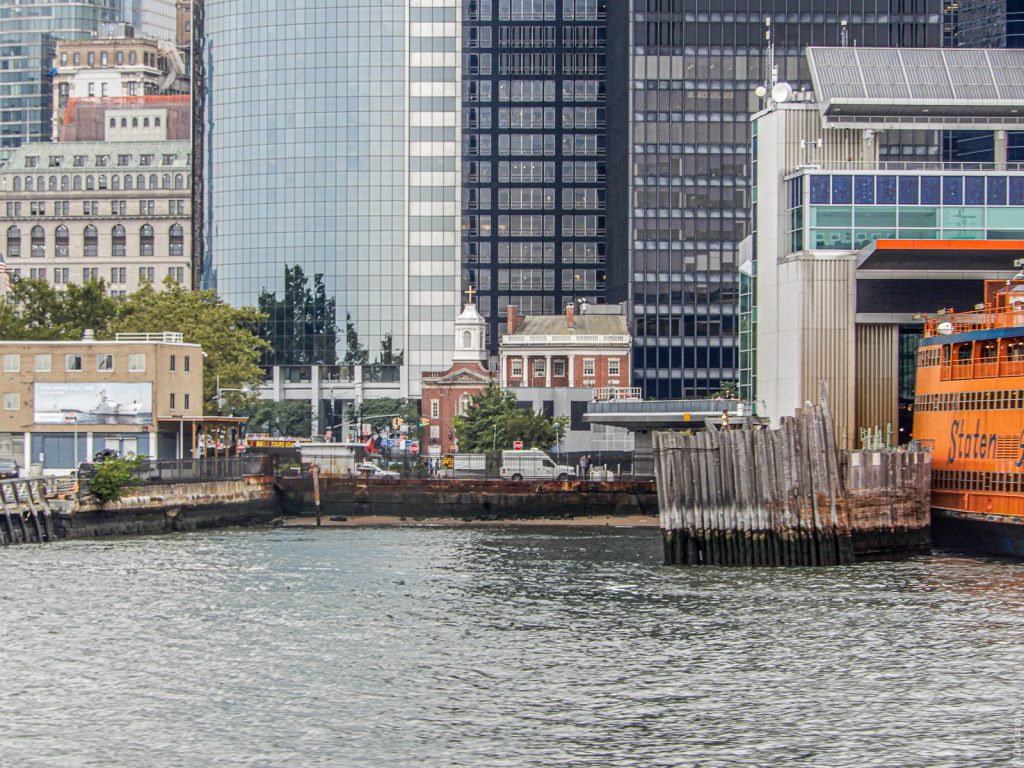
An Early New York Skyscraper
It may not be what you are thinking! It is the house of red brick with white trim right on the waterfront. This James Watson house was built in 1793 and extended in 1806. Watson was a wealthy business person and politician. Today it is a shrine to the Catholic Saint, Mother Elizabeth Seton. When the house was built, it was known as a “cloud scraper.”
This church is just a few steps from the Whitehall Terminal of the Staten Ferry on the east end of Battery Park. Carol and I used the church as a waypoint to our hotel, the Hilton Garden Inn NYC Financial District, just around the corner.
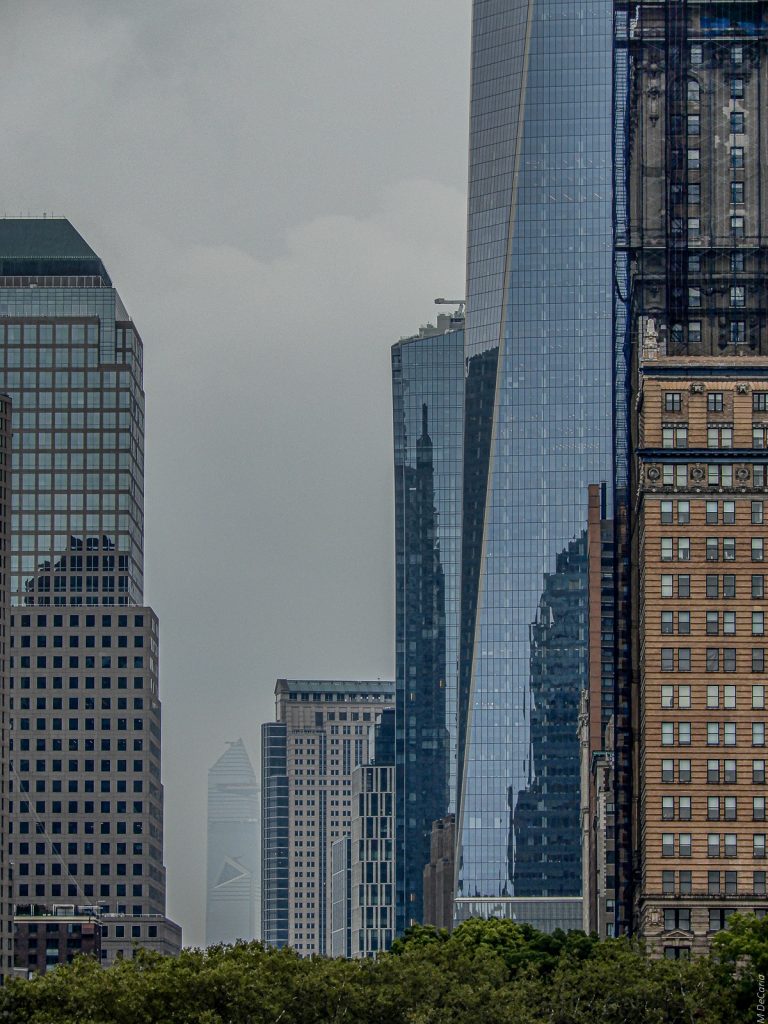
“West Street Canyon”
The treetops of Battery Park are in the foreground with 30 Hudson Yards and 10 Hudson Yards in the rain at the far end. 30 Hudson Yards at 1268 ft/387 m ranks third among New York skyscrapers. If you squint, a triangular observation deck juts from the top of the building just before the roof tapers. The slanted roof of 10 Hudson Yards creates the illusion of that black triangle on the side of 30 Hudson Yards. A mouse cursor on a real life cityscape repeatedly perplexed me! A day at Hudson Yards is on my agenda for my next visit to New York.

One World Trade Center from the Hudson River
Generic buildings along West Street occupy the foreground. The slender building to the right is 20 Exchange Place, a 57-story skyscraper. It is like the Empire State Building in two ways: It is art deco and was completed in 1931.

Empire State Building in the Rain
Speaking of the The Empire State Building, here it is and in the rain, no less!

Jersey City, New Jersey from the Hudson River
The Goldman Sachs Tower at 42 floors is at the far left. Just left of center, 99 Hudson Street, a 79-story condominium building is almost ready for occupancy. I like this study in gray.

Central Railroad of New Jersey Terminal
This extensive station once served as a waterfront terminal for boats and trains in Jersey City. Our boat guide said most immigrants who were processed through Ellis Island never stepped foot in New York. Boats took them here where they boarded trains for the interior United States. Domenick (b. Domenico) Decaria, my paternal grandfather talked of having spent 30 days on Ellis Island after his arrival from Italy in 1905. The immigration service gave him $10 and transportation to this station. He spent time in Pennsylvania; West Virginia; Gary, Indiana; and Preston, Idaho before finding his way to Ogden, Utah in 1913. Three years later he had become a journeyman boilermaker for the Southern Pacific Railroad, married Assuntina Concetta Villella, bought a house where he lived until his death in 1970, and partnered with my grandmother to raise eight children. Victor, my father, was the third of those children, born in 1924 and is still thriving. Assuntina arrived in America from Italy in 1912 with her parents and younger brother, and they also likely departed from this historic station, now a museum.
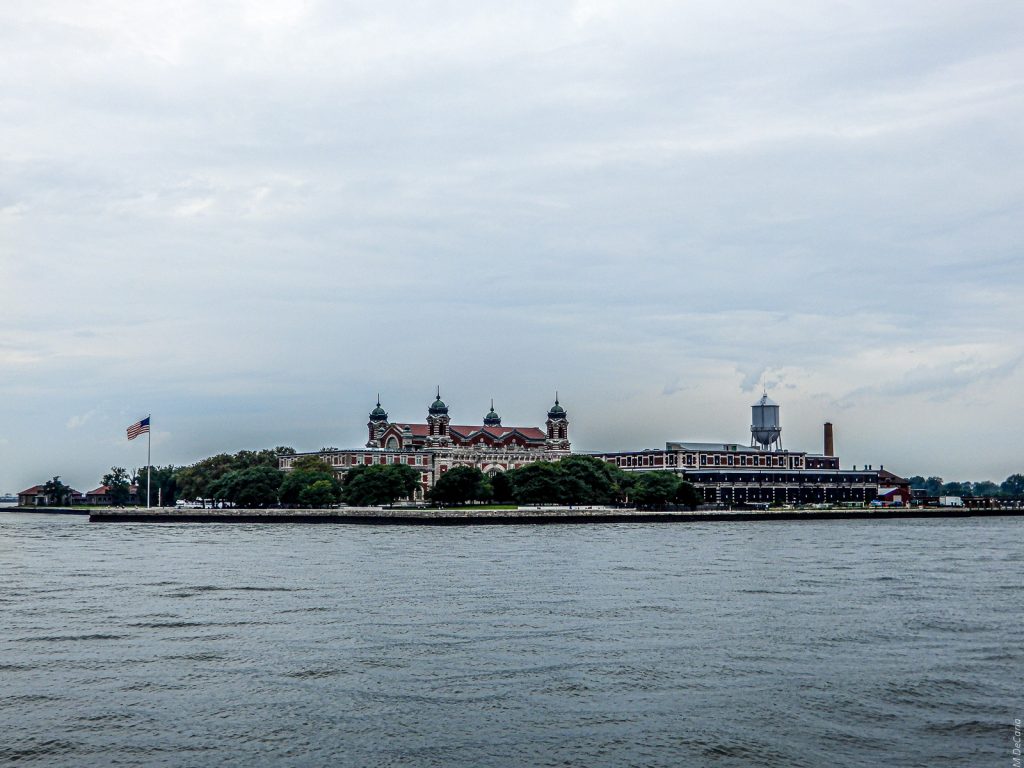
Ellis Island
Whether you are one of the millions of Americans whose family came through Ellis Island or not, you will almost certainly find a visit to this museum an emotional experience. There is a memorial on the grounds than contains names of some of the immigrants. During the building of the memorial, one of my brothers donated and had our grandparents’ names and hometowns recorded. Assuntina Concetta Villella; Motta Santa Lucia, Calabria, Italy. Domenico Decaria; Vallelonga, Calabria, Italy.

The Statue of Liberty
When my grandfather talked about his voyage from Italy to America, the two things he would regularly mention were the Strait of Gibraltar and the Statue of Liberty.
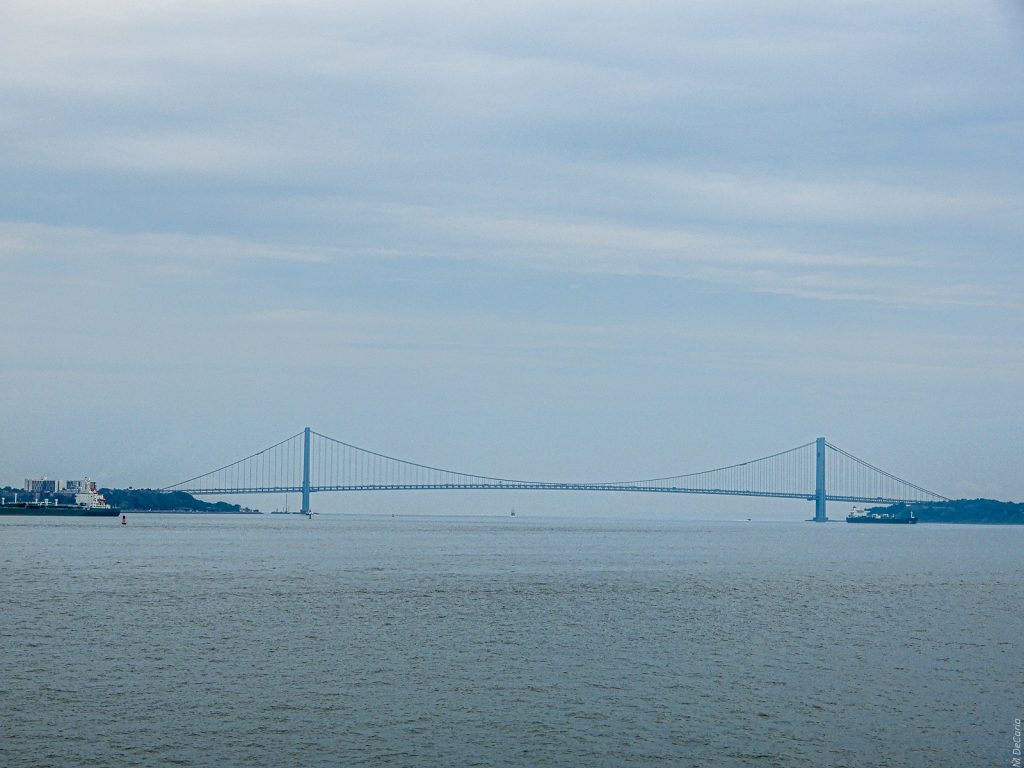
Verrazzano-Narrows Bridge
Brooklyn is on the left and Staten Island on the right. The Verrazzano Narrows is the entrance to the Port of New York and New Jersey. The narrows marks the boundary between the upper bay and lower bay of New York.

Marie’s 2 on Staten Island
Carol and I rode the Staten Island Ferry specifically to eat pizza in the St. George neighborhood of the borough. We were not disappointed. Carol was kind to pose for this photo.
Note that this is the only photo in this gallery not taken from a boat.
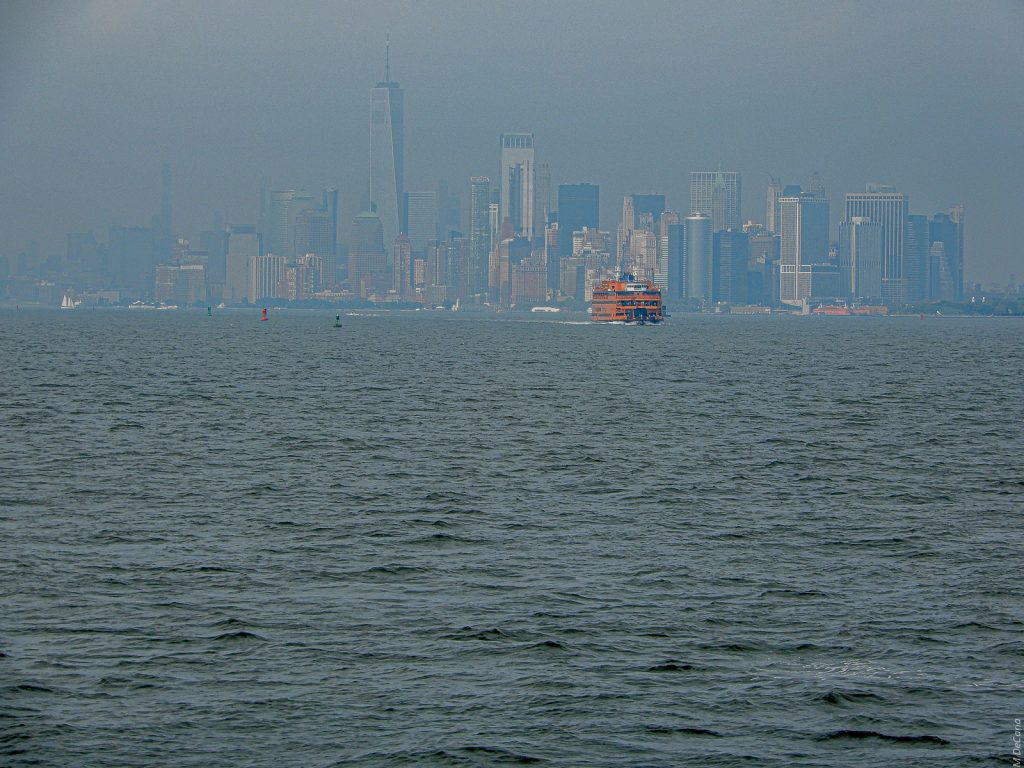
Lower Manhattan from the Staten Island Ferry.
Looking directly at the southern tip of Manhattan, the Financial District, where the East River, on the right, meets the Hudson River, on the left, to form upper New York Bay. We are on the way from Staten Island to Manhattan, and the ferry in the photo is headed the opposite way. On the far right you can spot two other orange ferries at the Whitehall Terminal. The rain and later afternoon sun combined for this unusual lighting which I was fortunate to capture.
I am very grateful to you who have looked at this post as well as my other posts. Upcoming posts will feature urban hiking in lower Manhattan as well as ports of call to Bermuda, Sint Maarten and St. Martin, Puerto Rico, and Haiti. Thank you all very much, Michael

Another great blog post! It was interesting to read about the ‘cloud scraper.’ I would love to go back in time and see the area when that building was the tallest structure around. Your images of West Street Canyon and the One World Trade Center are beautiful! My favorite of all the photos is the Statue of Liberty! Zoomed in and cropped in a contemporary style. Nice! I like the clean white of the background. I enjoyed your post.