Introduction
The evening of 29 April and the morning of 30 April 2022 featured an alignment of the five naked eye planets. Mercury in the evening, and Venus, Jupiter, Mars, and Saturn in the morning. The visibility of all five planets in a 24-hour period is unusual because their orbits often carry one or more of them close to the Sun. Two things made this April lineup special: Mercury was adjacent to the Pleiades, and Jupiter and Venus were closely paired. Because planets move swiftly, these chance alignments sometimes last only a few hours.
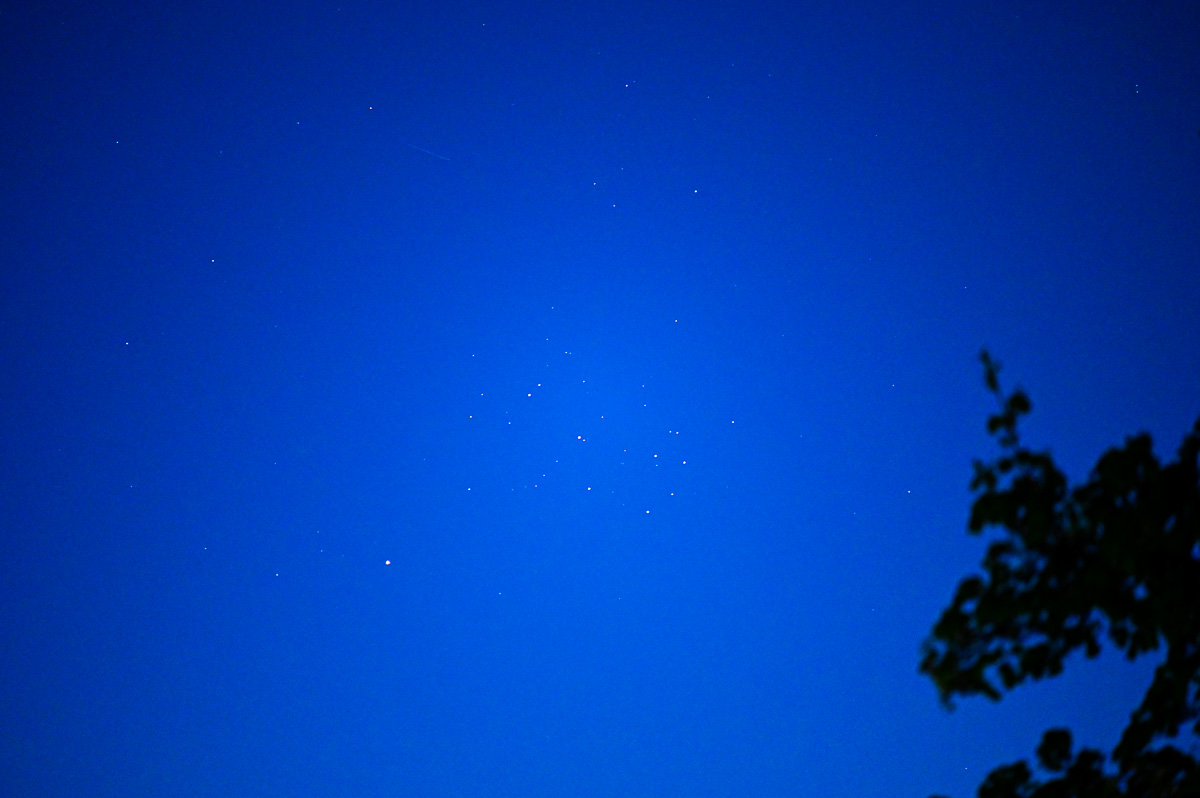
Mercury Meets the Pleiades-29 April 2022 Evening
Mercury is the brightest point just to right and below the center of the frame. The Pleiades are an open star cluster and form the small dipper in the center.
A property of space that fascinates me is, well, space. Another is dimensionality. Here Mercury is 125 million kilometers (76 million miles) away. Relatively close. The Pleiades are about 380 light years away. Far compared to Mercury.
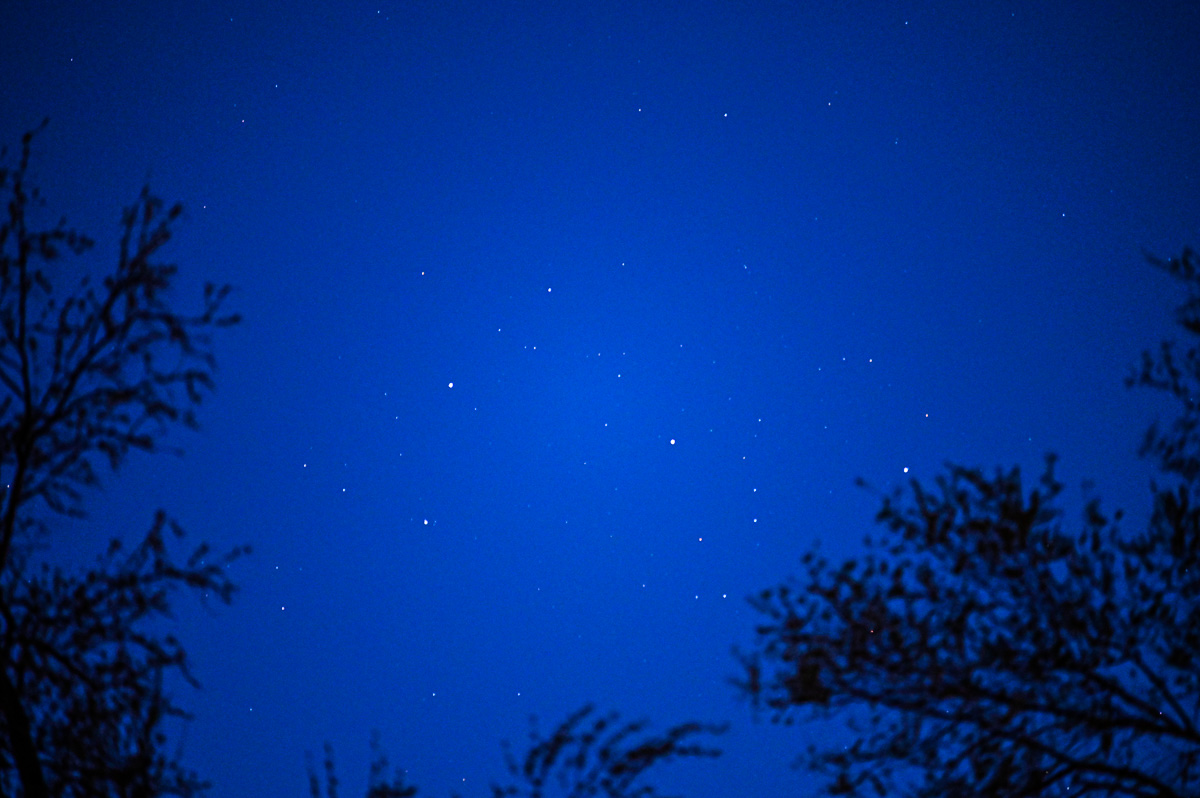
Orion’s Belt-29 April 2022 Evening ((As Mercury was setting I used the opportunity to take this photo and the next one, although neither contained a naked eye planet.))
I never before realized how beautiful Orion’s Belt is until I saw it isolated from the rest of the constellation. Left to to right: Alnitak (826 light years), Alnilam (1359 light years), and Mintaka (919 light years). Sigma Orionis (1165 light years) hangs below Alnitak. These identified stars and most of the fainter ones here are part of a loose association (Collinder 70) moving in the same direction through the galaxy.
An imaginary line drawn from Orion’s belt to the left leads to Sirius, the subject of the next photo.
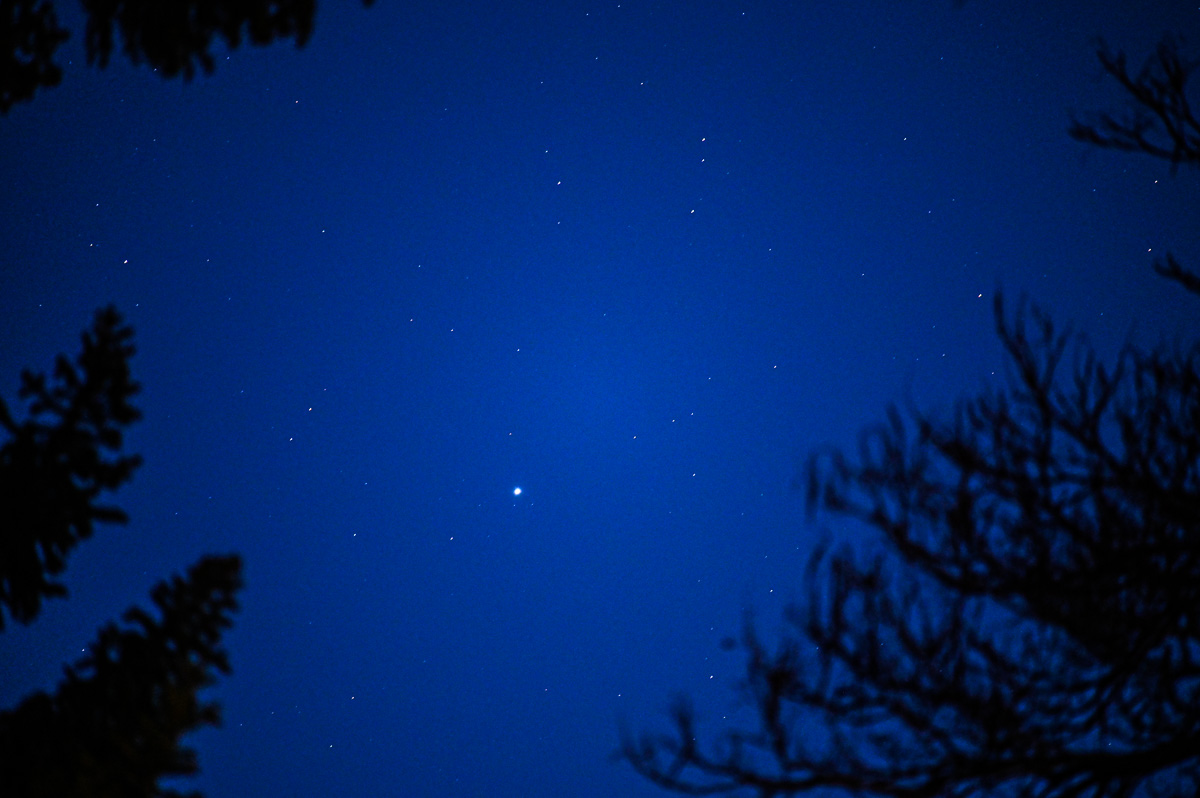
Sirius-29 Apr 2022 Evening
Sirius is the brightest appearing star, not only in this photo but of all the stars seen at any time. ((Of course, the Sun is the by far the brightest star from our earthly vantage point. Think about this: “If the Sun is a star, why can’t we see it at night?”)) If you are new to astronomy, noticing the brightness of celestial objects relative to themselves and each other adds enjoyment to the hobby.
Sirius at 8.7 light years away is one of the closest stars to us. Just for fun those stars to the left of Sirius range from 375 to 1553 light years.
Again, here is the dimensionality of space: Sirius in the foreground far removed from those distant stars.
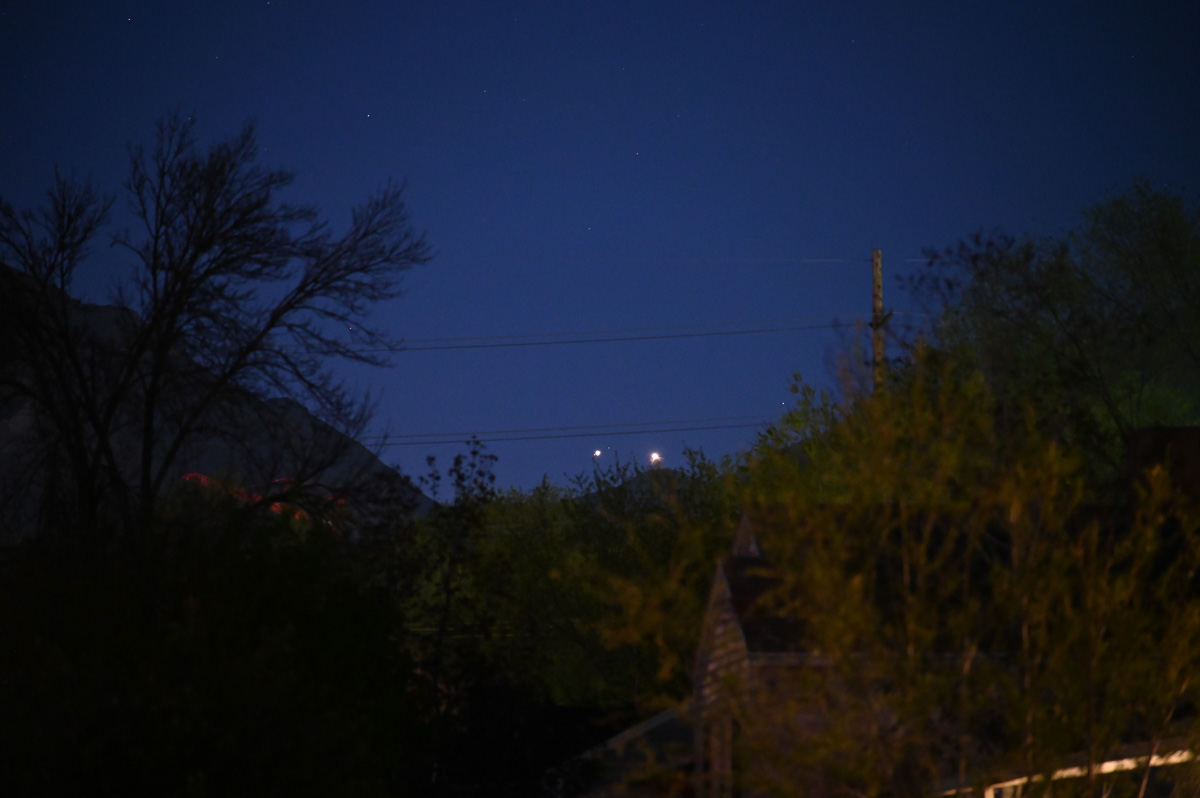
Jupiter and Venus Rise Together-30 Apr 2022 Morning
I always experience a thrill when I see a planet or bright star on the crest of the Wasatch Mountains. Seeing the two brightest planets only a half degree apart was extra special. Jupiter is on the left and Venus on the right.
Mars and Saturn-30 Apr 2022 Morning
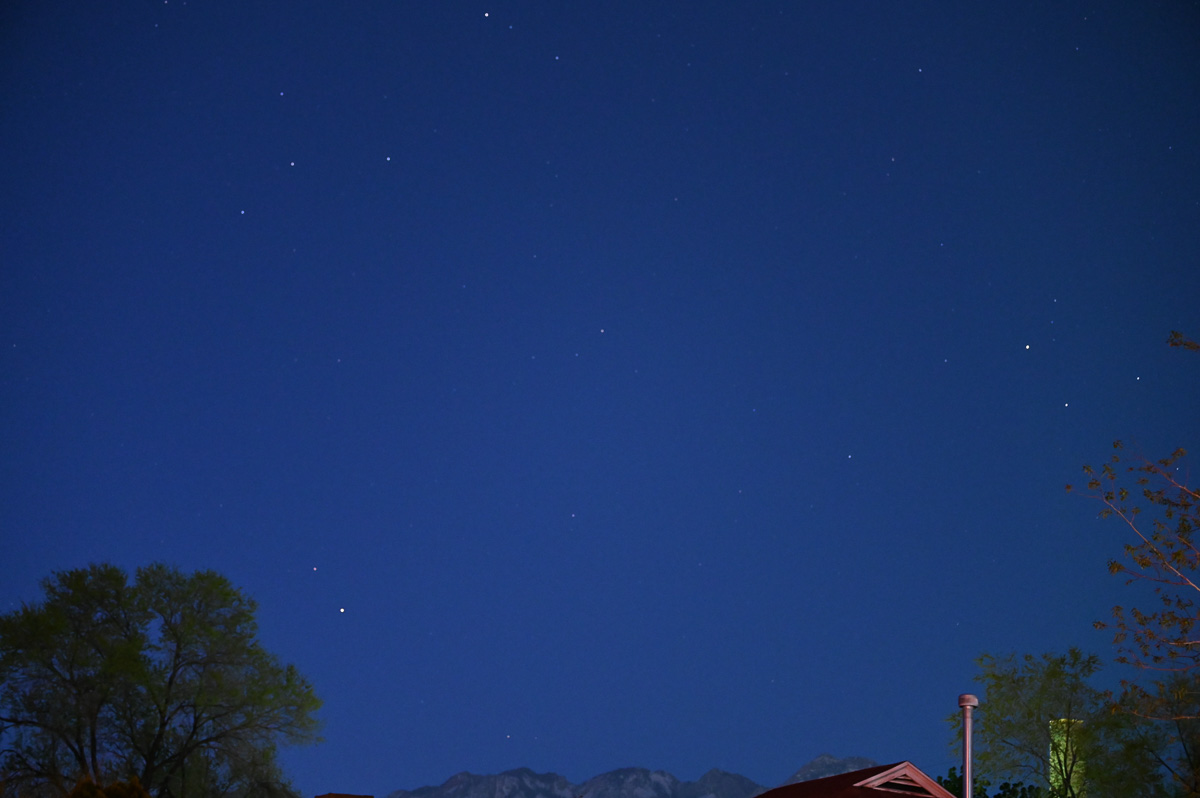
Saturn is the brightest of the three objects on the far right. Mars is the brighter of the two objects by the tree to the left. Saturn is in the constellation of Capricorn and Mars in Aquarius.
Saturn’s ring system is visible in any telescope now. Saturn will be at its best from 1 July to 30 September and at its very best in mid August.
Mars is too far away to reveal any detail in amateur telescopes, but that will change in the weeks surrounding 7/8 December 2022.
Jupiter, Venus, and Mars-30 Apr 2022 Morning
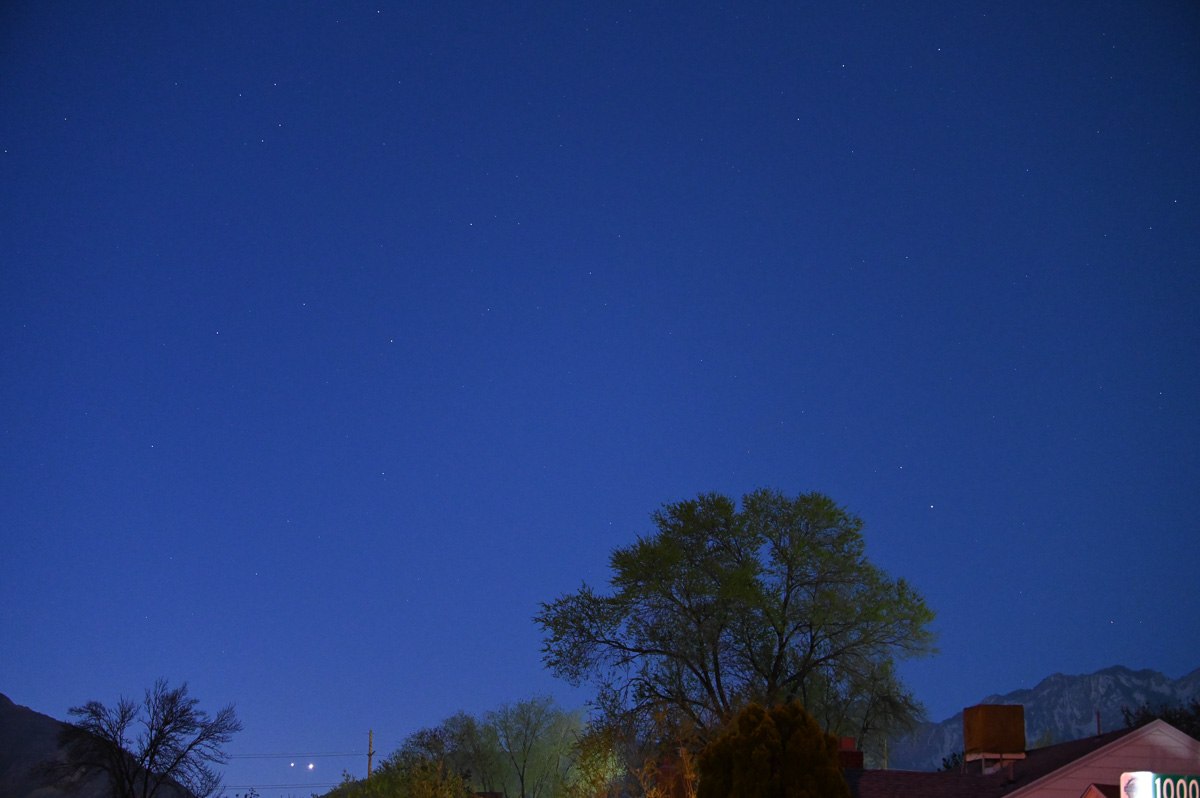
Jupiter and Venus have risen above the saddle in the Wasatch crest. Mars is the brighter of the two objects to the right of the top of the tree.
Both Venus and Jupiter are bright enough to see in full daylight. I reluctantly left the duo behind to do other adventures on this Saturday morning.
Endnote
Clouds often interfere with observing special astronomical events. Fortunately, this parade of planets was sandwiched between two storm systems. I was disappointed two days ago when a cloud deck moved in just before moonrise to hide a total lunar eclipse. No worries, another one is coming in November 2022.
Thank you,
Michael DeCaria
“Make visible what, without you, might perhaps never have been seen” -Robert Bresson

Very nice Mike! Wonderful images.
Hi Alex, For anybody like you who has spent time observing the night sky with a telescope, these images can have meaning. I am delighted that you connected with them. I fear that people who have not yet learned to see the night sky with optical aids, may find the images confusing. I have attempted to point out the dimensionality and emptiness of space so that people will experience what there is to see and more importantly, what there is not to see. Thank you! Michael
Oh, how I liked this post! To observe the stars in the dim light is a treat indeed.
Hi Susie, Observing the heavens is, indeed, a treat! It is edifying that these photos convey some sense of actually observing. If you look carefully at Jupiter in the the featured photo, you can see Ganymede hugging Jupiter to the left. Callisto is three Jupiter diameters to right. You may have to enlarge the image a little depending on your device. Thank you! Michael