Comets have fascinated me since Comet Mrkos in 1957.
When Mrkos appeared, I was a child in the then farm town of Layton, Utah.
My father had roused me and my siblings at 4:00 a.m. to see Mrkos.
The long tail of the comet shot straight up like a search light into black sky from behind the wall of the Wasatch Mountains barely east of our house.
I didn’t then and still don’t have the words to describe the awe I felt.
Therefore, whenever I hear about a comet, I want to see it.
Here is an account of observing Comet C/2023 A3 Tsuchinshan-ATLAS (Comet A3) from Millcreek, Utah:
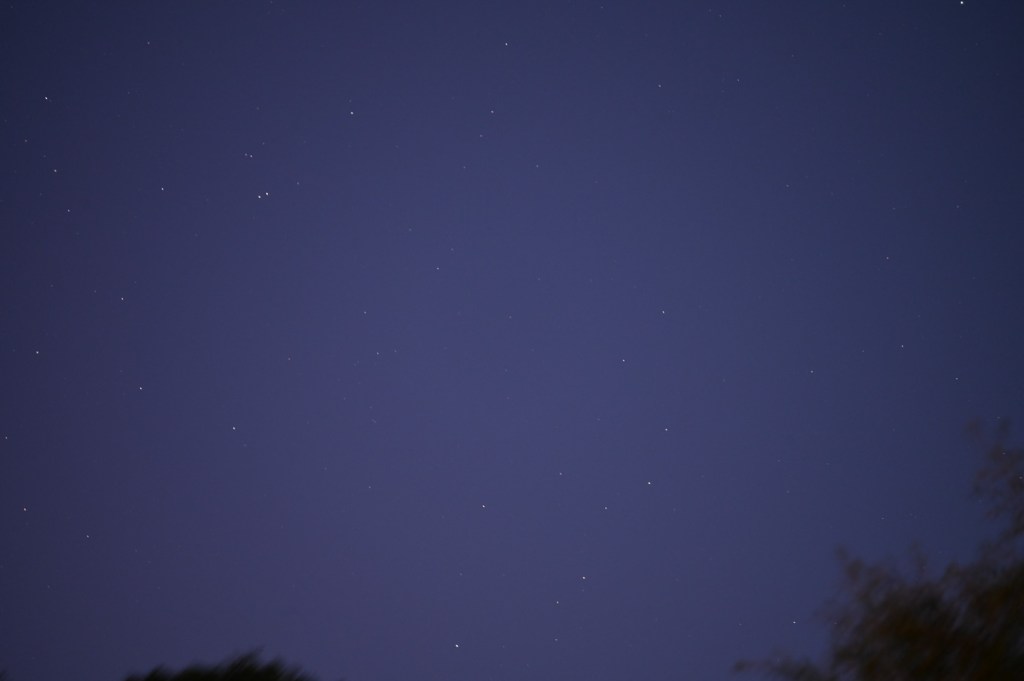
Where was Comet A3? (September 27, 2024)1Nikon Z6, 300mm, f/6.3, 30 seconds, ISO 800, Nisi natural light filter (27 Sep 2024 0012 UTC)
Comet A3 was a theoretical possibility for us northern hemisphere observers to see for the first time on this Friday morning.
I captured this photo 45 minutes before dawn and I had hoped to observe the comet’s tail…
…just like Mrkos nearly 70 years ago.
If the tail existed, it would have entered the frame one-fourth the distance from the bottom left and extended at a 30-degree angle almost to the center line.
But no.
Not even with this 30-second exposure and me crazedly playing with Adobe Photoshop Lightroom sliders.
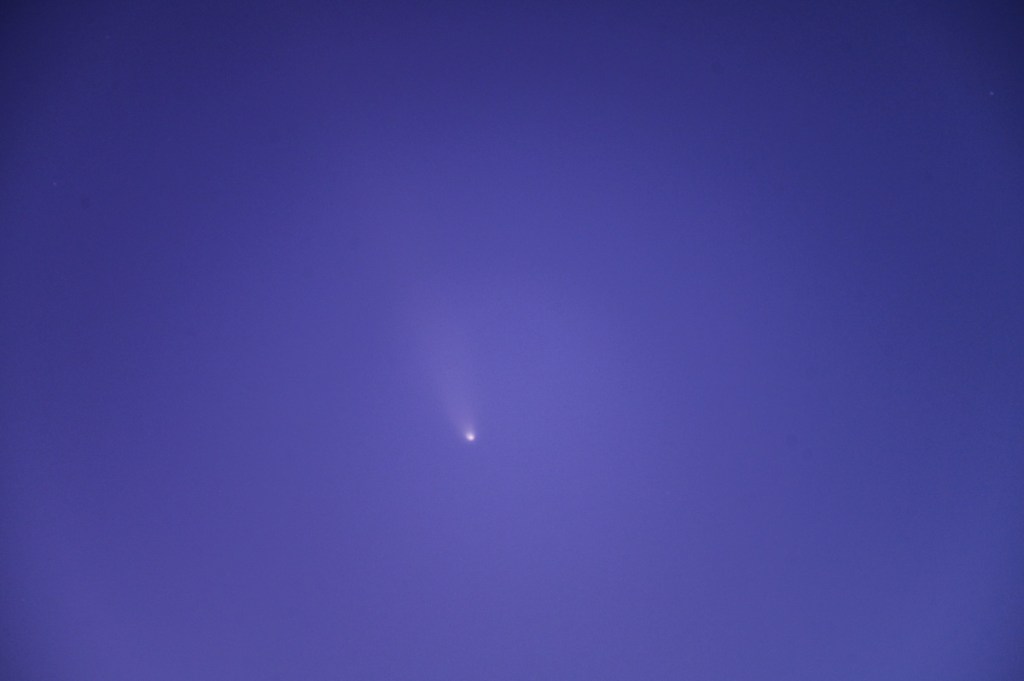
Comet A3 (October 13, 2024)2Nikon Z6, 500mm, f/5.6, 1.6 seconds, ISO 800, Nisi natural light filter (14 Oct 2024, 0134 GMT)
Sixteen days later, here is Comet A3 in the evening sky.

Comet A3 (October 13, 2024)3Nikon Z6, 200mm, f/5.6, 2 seconds, ISO 800, Nisi natural light filter (14 Oct 2024 (1350 GMT)
As the sky darkens, the tail becomes more prominent.
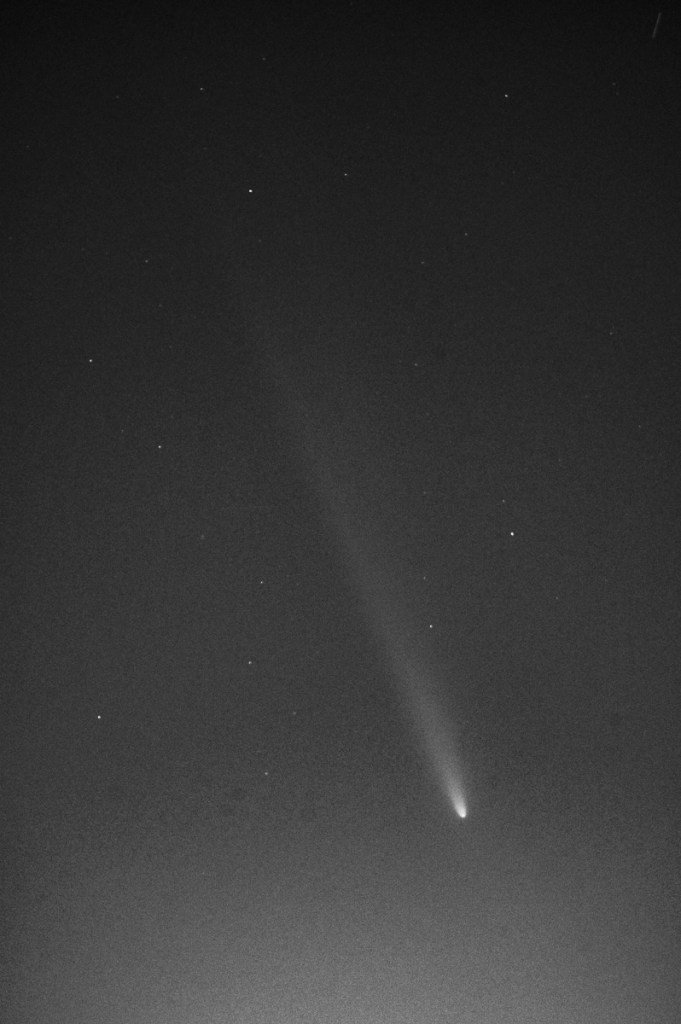
Comet A3 (October 13, 2024)4Nikon Z6, 200mm, f/5.6, 2 seconds, ISO 800, Nisi natural light filter (14 Oct 2024 (1356 GMT)
Portrait format and black and white rendering show off the length of the tail.
The tail measures 7 degrees or the width of 14 full Moons.
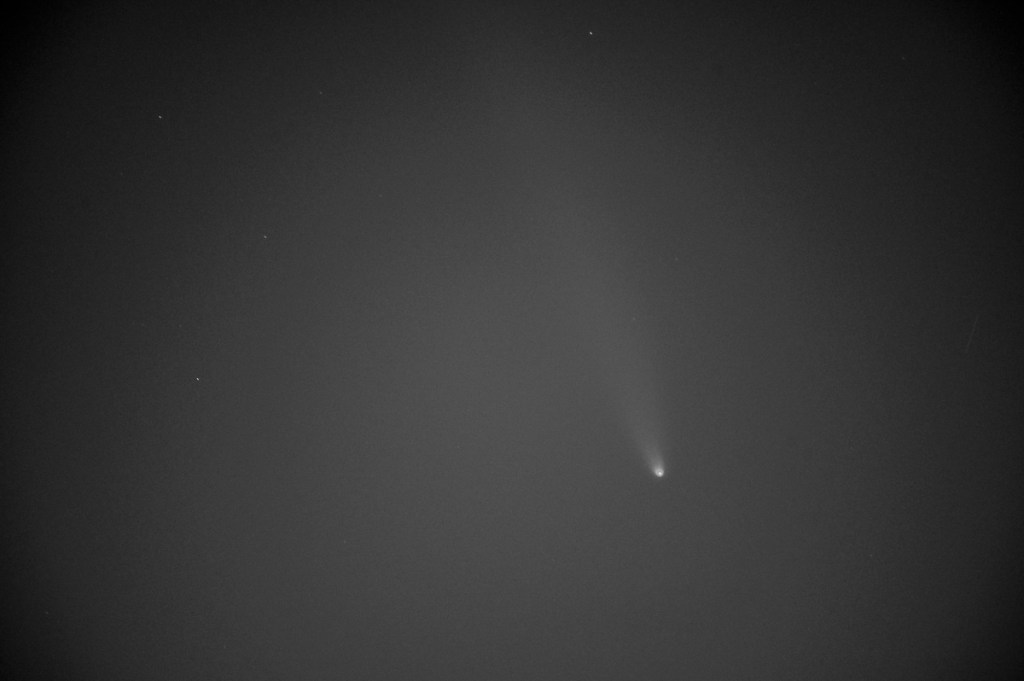
Comet A3 (October 13, 2024)5Nikon Z6, 200mm, f/5.6, 2 seconds, ISO 800, Nisi natural light filter (14 Oct 2024 (1400 GMT)
This black and white rendering reveals the compact nucleus in the comet head surrounded by the coma.
The nucleus is about 3.2 kilometers (2 miles) in diameter.
The coma and tail are made of gas and dust that the Sun’s heat releases from the nucleus.
When the comet escapes the solar system, the coma and tail will no longer exist.
Endnotes
- All photos taken from my backyard in Millcreek, Utah.
- Time-lapse exposures and telephoto lenses made these images possible. Comet A3 was not visible to the unaided eye except as a smudge, and then only if one knew where to look.
- Every comet has its own personality. For example, Comet Halley is rotund with a nucleus nearly four times that of Comet A3. If you are new to comet watching, you can enhance your enjoyment by looking for individual differences among comets.
Thank you for visiting Thecosmos.blog.
Your host,
Michael DeCaria
- 1Nikon Z6, 300mm, f/6.3, 30 seconds, ISO 800, Nisi natural light filter (27 Sep 2024 0012 UTC)
- 2Nikon Z6, 500mm, f/5.6, 1.6 seconds, ISO 800, Nisi natural light filter (14 Oct 2024, 0134 GMT)
- 3Nikon Z6, 200mm, f/5.6, 2 seconds, ISO 800, Nisi natural light filter (14 Oct 2024 (1350 GMT)
- 4Nikon Z6, 200mm, f/5.6, 2 seconds, ISO 800, Nisi natural light filter (14 Oct 2024 (1356 GMT)
- 5Nikon Z6, 200mm, f/5.6, 2 seconds, ISO 800, Nisi natural light filter (14 Oct 2024 (1400 GMT)

Very cool! Love the pictures.
Hi Alex, I am glad you liked the pictures. They are the first ones I have ever taken of a comet. Best, Michael
i remember Mrkos !
Great memories, great pictures!
Proud that you are my Brother,
Thank You,
Don
Hi Don, Thank you for the wonderful comments! I treasure our lifelong, mutual explorations in astronomy since Mrkos. Likewise, I am honored to be your brother, Michael