Questing for a very old Moon
The Moon “disappears” the day before, the day of, and the day after its new phase. Observing the extremely thin crescent less than 36 hours before and less than 36 hours after the exact moment of new requires planning and luck. Because ultrathin crescents have delicate beauty, seeking them is worth the effort. Twice I have observed the Moon at 28 hours. On 18 May 2023 I had a chance for a personal record of a 26 hours. On that day I happened to be in Kanab, Utah for the 2023 Nightscaper Photo Conference. Thanks to the PeakFinder App, I knew exactly where and when the Moon would rise over the red rock which borders the east side of town. The Moon would clear the crest of the mini mountain about 50 minutes before the Sun. What could go wrong?
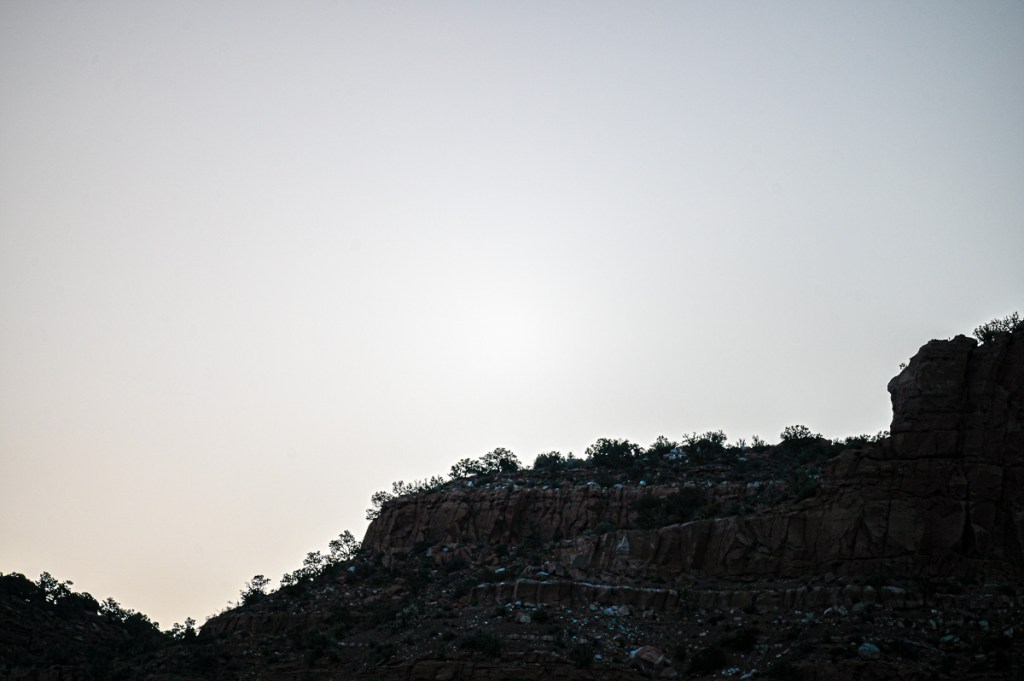
Moonrise Kanab, Utah 18 May 2023 @ 6:24 a.m. (MDT)
This is what could go wrong. Where was the Moon? It should have started rising at 6:18 a.m. and be fully risen. I didn’t see it. I will explain later in this post where it was, but a few more pictures first.

Sunrise Kanab #1
As a consolation for not seeing the 26-hour old Moon, I turned to the north to see this orange and vermillion cliff lit up by the rising Sun. I knew this unusual light would not last for more than a few minutes.
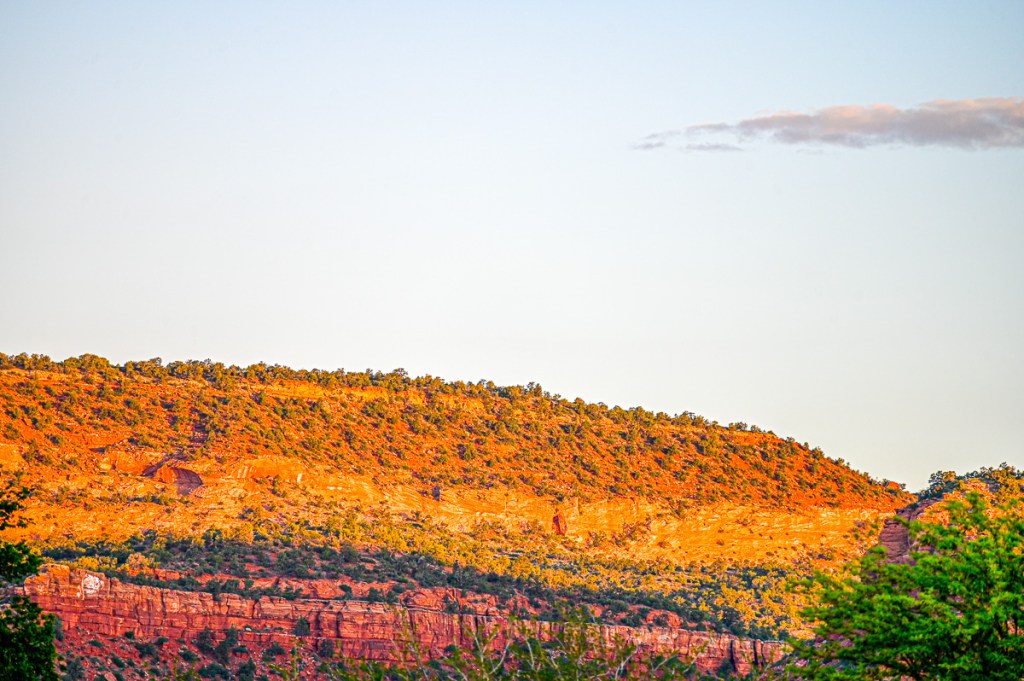
Sunrise Kanab #2
Although my original goal of the morning had a setback, I was thrilled by this scene.

Sunrise Kanab #3
Notice the gray cap of Navaho sandstone on the clifftop with the straight walls of red-purple Kayenta formation immediately beneath. Then the Navaho and Kayenta repeat lower, although they had originally formed at the same elevation. Just imagine those geological forces (and they are still happening).
Finding the old Moon
As I drove home from Kanab to northern Utah, I hoped the pixels of the old Moon might be in the camera. Before unpacking I hurried to my desktop computer. I eagerly put the media card in the tower, loaded Lightroom, and played with its sliders. Then this image appeared:
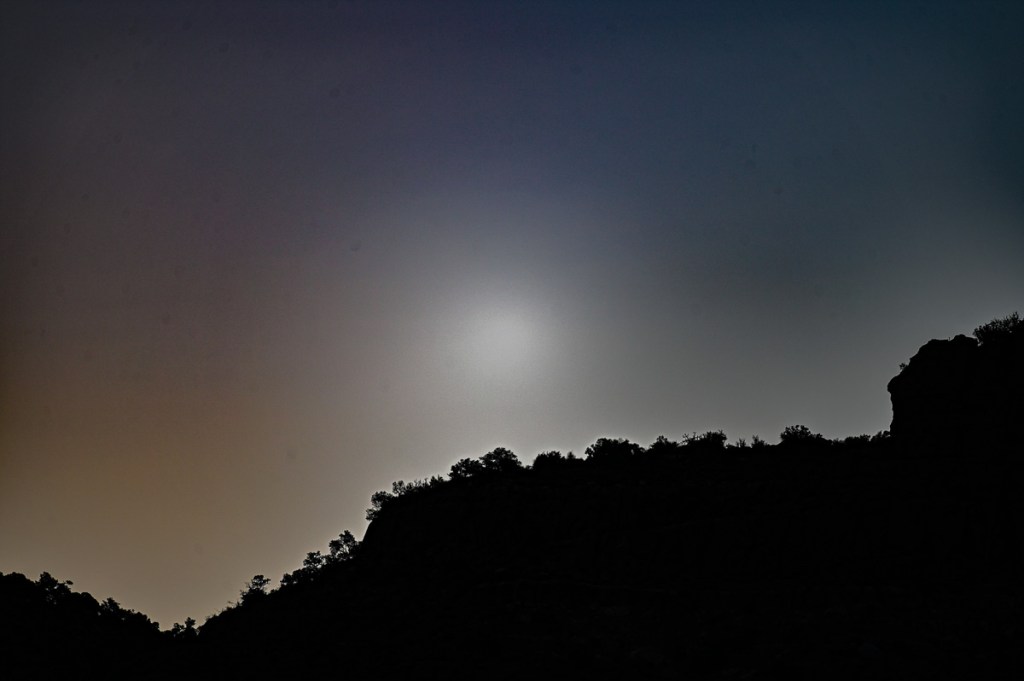
Moonrise Kanab, Utah 18 May 2023 @ 6:24 a.m. (MDT)
This image is a virtual copy of the first photo in this post but with Lightroom postprocessing (highlights slider full left and dehaze slider full right). At first I could not figure out the white circle of light. Then I realized that the Moon was experiencing a full Earth. Earthshine completely illuminated the near side of the Moon and then the near side could pierce, though only barely, the glare of the Earth’s atmosphere. Of course, the ultrathin crescent is lost to view. The Moon was right where the Peak Finder app said it would be.
Bonus: The New Moon
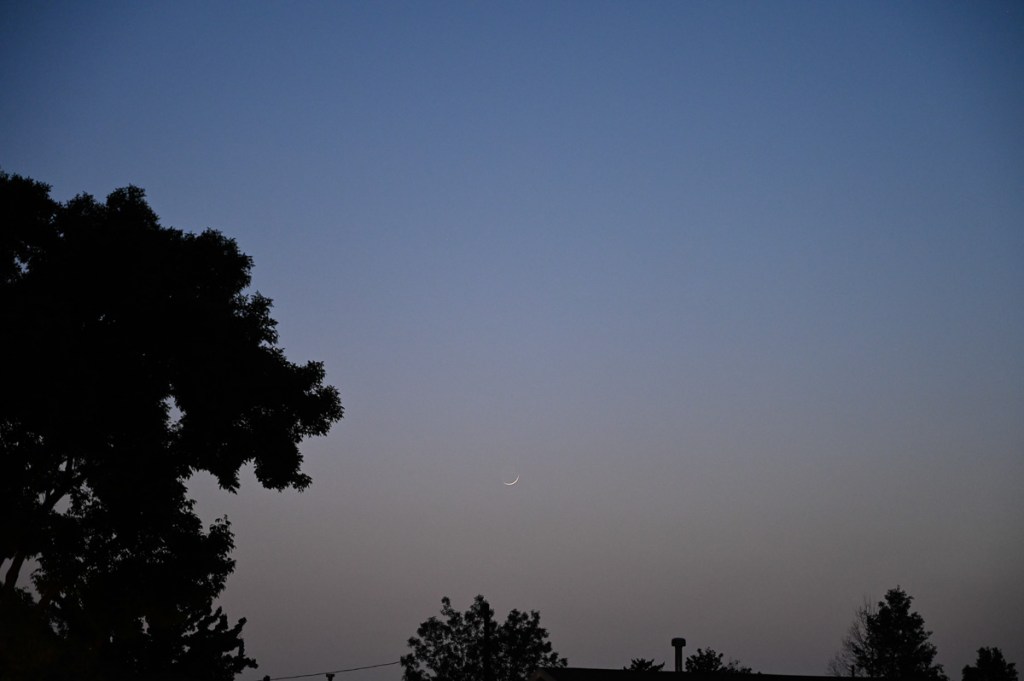
Moonset Salt Lake City, Utah 20 May 2023 @ 9:24 p.m. (MDT)
Two days after the above photos, here is the new Moon at 35 hours and 31 minutes. This thin crescent is what I had naively expected two days ago, except as an old Moon. Here our natural satellite sinks into wildfire smoke that had drifted south to Utah from northern Alberta and British Columbia.
Michael DeCaria
Make visible what, without you, might perhaps never have been seen – Robert Bresson

Very cool!
Hi Alex, I enjoyed solving the mystery of the missing Moon. I am delighted you looked in on the post! -Michael
Michael, you have a lot pf patience and determination! Your explanation and images were fascinating. The capture of the intense sunlit cliffs was beautiful and you’re right, the bonus of that tiny fingernail moon image was worth it!
Hi Susie, I am constantly amazed by the beauty in the world, but it is rarely in the place where I am looking. Thank you for your patience in following story! -Michael
So much content in such a short space with words and pictures. I always learn so much from your posts. Science, aesthetics, art, physics, techniques, thoughts, predictions, assumptions, test hypothesis, and just plain beauty and happiness exploring what to others might be pedestrian or superfluous. Well done Mike. Keep these coming.
Hi Darrin, Your comment has touched me deeply because you are a deep thinker and well read. Thank you! -Michael