Orion’s Belt and Sword
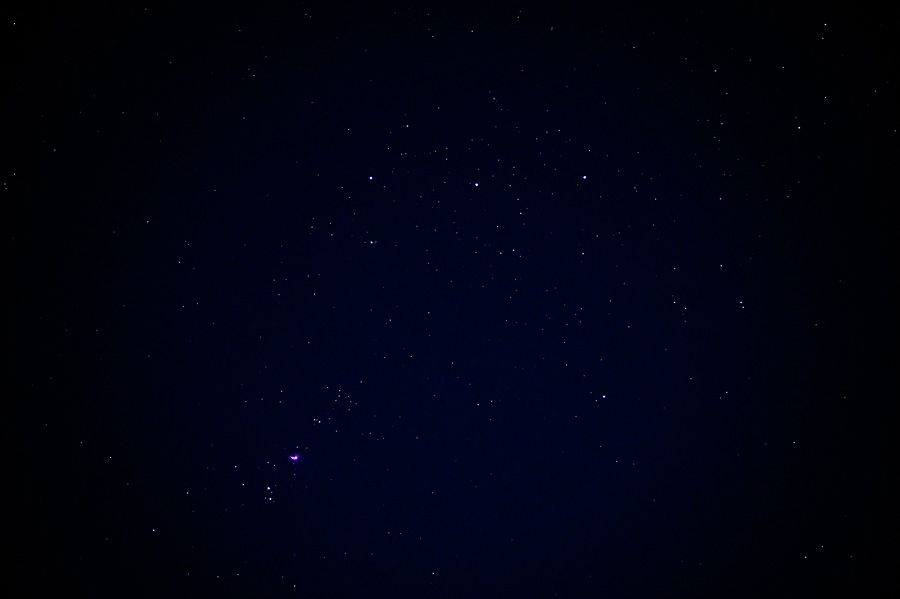
 The two most recognizable asterisms are the Big Dipper and Orion’s Belt. Here is one of them, the hunter’s belt.
The three stars of the belt are left to right: Alnitak (1260 lightyears), Alnilam (2000 lightyears), and Mintaka (1200 lightyears).
Orion’s sword hangs down to the left. The middle “star” of the sword is actually a huge star factory known as Messier 42 (M42) and is 1344 lightyears distant.
Orion’s Belt is a guide to the next picture. Please read on for more.
Hyades, Pleiades, and Venus
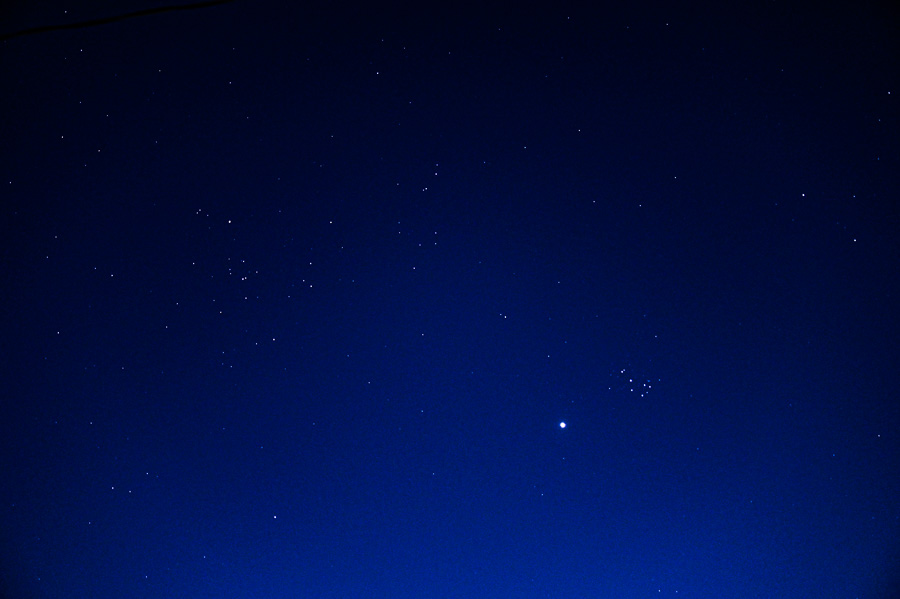
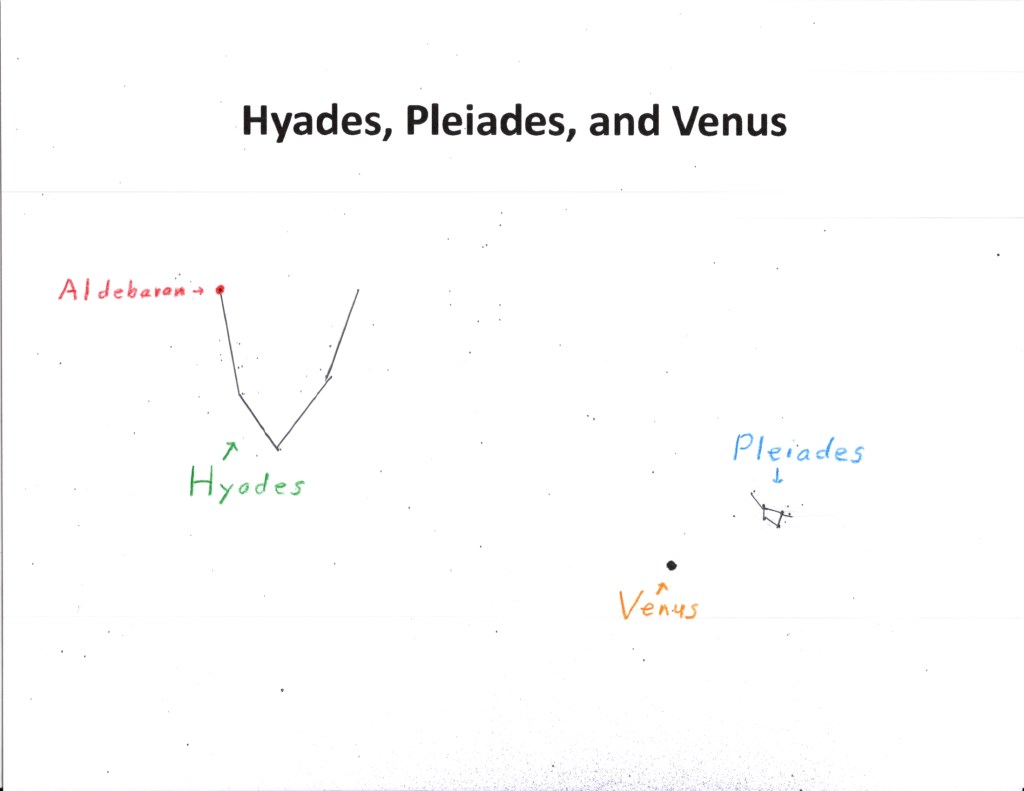
Extending a line from Orion’s Belt to the right brings us to the V of Taurus’s face and the tiny dipper of the Pleiades (Taurus’s shoulder).
Hyades and Pleiades are the two closest open star clusters to Earth. They are awe inspiring to the unaided eye and to low magnification with binoculars.
Hyades form the open star cluster to the left. They are an asterism, a recognizable part of a larger constellation, here Taurus the Bull. The cluster lies 151 lightyears away and has a diameter of 10 lightyears. Aldebaran is the bright red star on the left horn of the V. Aldebaran is the eye of the bull while the V is the face. Aldebaran is part of the Hyades cluster by line of sight only and is 65 lightyears away. Please note that Aldebaran is not red in the photo because the blue filter I used to eliminate yellow light pollution also eliminated any red color.
The Pleiades are also an open star cluster and another asterism in Taurus. The Pleiades are 444 lightyears away and are 17.5 light years in diameter. If the Pleiades were as close to us as Hyades, the former’s larger size would would dominate the night sky.
Venus is the brightest object in the sky after the Sun and the Moon. On truly dark nights, I have seen Venus shine so brightly that it could cast a shadow. I have also observed Venus in broad daylight. Here on 11/12 April 2023 Venus was sliding between Hyades and Pleiades. You can continue to enjoy our twin planet every clear night over the next several weeks. Around sunset and for three hours after, Venus will shine so brightly in the western/northwestern sky (for observers in the midlatitudes and higher of the northern hemisphere) that you cannot miss it. See how out it outshines every other object in the night sky (except the Moon as noted above).
Endnote
As I publish this post in mid May, Orion’s Belt and the two great star clusters are setting with the Sun and are no longer visible. Before sunrise in late July, however, Orion will be lying on his side along the eastern horizon. His belt will point straight up to Hyades and the Pleiades. Please look for them. I always enjoy Orion lying on the Wasatch Mountains before midsummer dawns. This year I will photograph the scene and post it for you. I can hardly wait!
Michael DeCaria
Make visible what, without you, might perhaps never have been seen – Robert Bresson
