Hello Readers,
When the Moon hides another celestial body, the event is called a lunar occultation.
On 18 June 2026 the Moon occulted Venus; in other words, the second brightest object in the sky slid in front of the third brightest and concealed it for 82 minutes.
This daytime event was visible because Venus’s brilliance can penetrate the sunlit sky. But you have to know where to look. On that day the crescent Moon served as a signpost.
Here are four photos of the event:
2:00 pm MDT (UTC-6)
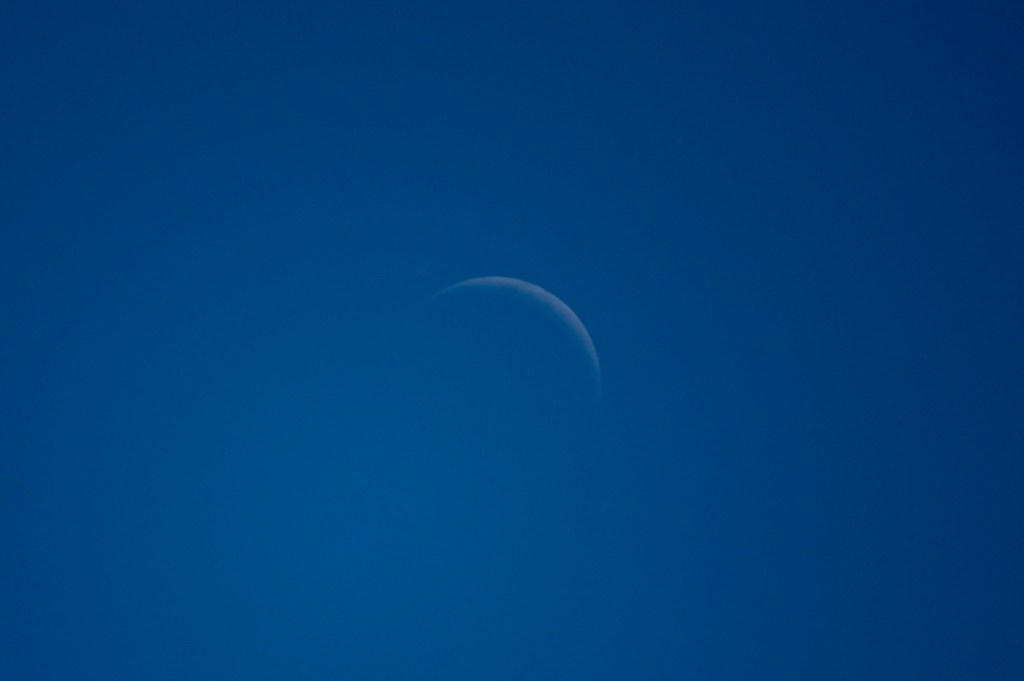
The Moon Hiding Venus
Venus had disappeared behind the unlit portion of the lunar disc at 12:44 pm.
The spot of disappearance was at seven o’clock if you can imagine the complete lunar disk as a clock and the top of the photo being twelve o’ clock. (I apologize for having real time and an imaginary clock playing with each other.)
In the minutes before the disappearance, the Venus looked like a parachutist with the crescent being the canopy.
I have no photos of the disappearance because I had not prepared. I took for granted my ability to capture the very thin crescent in the bright sky despite low contrast between the very thin Moon and the bright sky.1During the disappearance of Venus, I switched from a 500mm to a 200mm lens, added a polarizing filter, and reduced the aperture from f4 to f8. Those three changes along with the event climbing higher above the horizon allowed the the capture of the above image and the following two. I will experiment in the coming days to see which of the four factors, or combination of them, worked.
2:06 pm MDT (UTC-6)
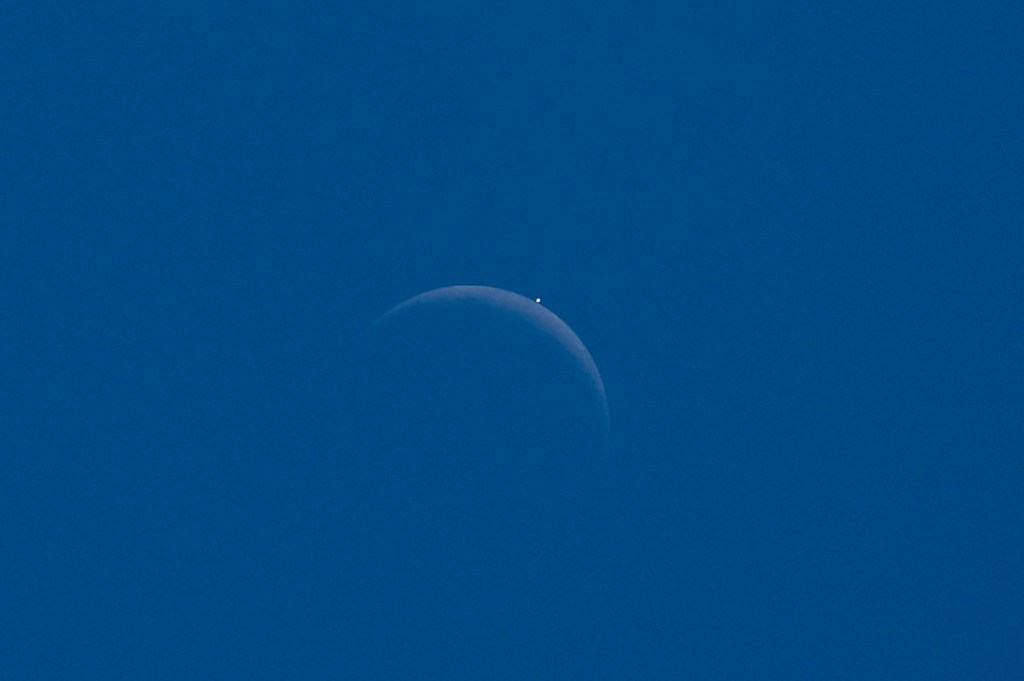
Venus Reappears
Eighty-two minutes after the disappearance of Venus, the Moon’s motion finally revealed the Earth’s sister planet.
2:17 pm MDT (UTC-6)
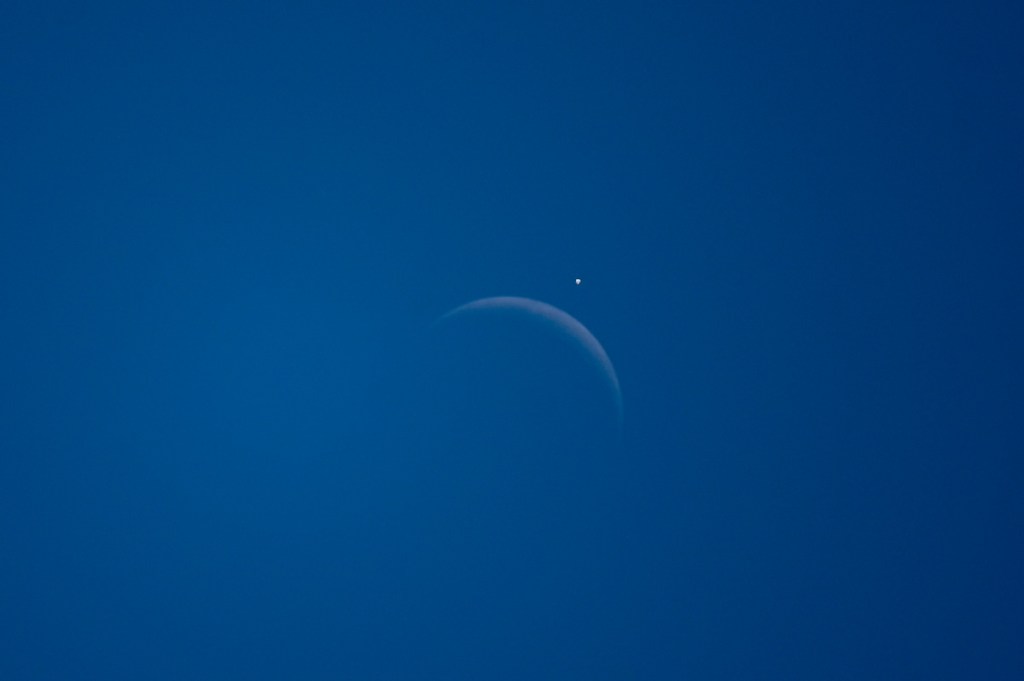
The Moon Separates from Venus
Eleven minutes later.
9:54 PM MDT (UTC-6)

The Moon, Venus, Jupiter, and Mercury
Almost eight hours after Venus reappeared.
The Moon has now moved roughly seven of its diameters beyond Venus.
Jupiter appears in the center of the frame.
Mercury is low in the sky slightly above the right vertical edge of the trees. Spotting Mercury in the photo may be a test of your device’s resolution.
Endnote
Three aspects of lunar occultations excite me:
The first is the five minute span before the disappearance. During that time you can actually see the Moon’s motion in real time as it barrels toward the object to be occulted (here Venus).
The second and third are the disappearance and reappearance of the occulted object. Those two phases of the occultation are not instantaneous. Instead, the object is swallowed gradually and then spit out gradually over the course of some seconds.
I know I did not convey these events in this post, but they are awesome to observe through a telescope or binoculars mounted on a tripod.
Thank you very much for looking at this post, and I eagerly look forward to your comments.
Best regards,
Michael DeCaria
Thecosmos.blog
“Make visible what, without you, might perhaps never have been seen.” -Robert Bresson
- 1During the disappearance of Venus, I switched from a 500mm to a 200mm lens, added a polarizing filter, and reduced the aperture from f4 to f8. Those three changes along with the event climbing higher above the horizon allowed the the capture of the above image and the following two. I will experiment in the coming days to see which of the four factors, or combination of them, worked. ↩︎

Very cool! I never thought about Venus being visible in the daytime until talking with you recently. And now I want to see an occultation.
This was a very enjoyable occurrence. Michael is not only a great photographer, story teller and blog author, he is a friend and neighbor too.
Typically we have shared astronomical events behind the eyepiece of his telescope at night. So this was a special event as Michael told me beforehand, you can see Venus with a naked eye in the daytime. (And that it is even better with just simple binoculars.)
My wife Lisa was interested in this daytime “show” as well.
We ran across the street and Michael was able to show us where to look and what to look for. I had heard (probably from Michael before) that one can see Venus with the naked eye if you know where to look and this was our first time. This was a wonder that I think few folks have experienced in person…Seeing a planet in the daytime.
I was able to share with my friend Mac, via phone, as the process unfolded as well. It was a day of shared friendship and awe, because of Michael’s curiosity and passion.
And now the experience of that day is recorded here with these spectacular visuals of the Moon and Venus and I really enjoyed seeing the evening photo with Venus being joined by Jupiter and Mercury as well.
Thank you Michael for all the impact you made on me and others with your “doing and sharing”.
Darrin